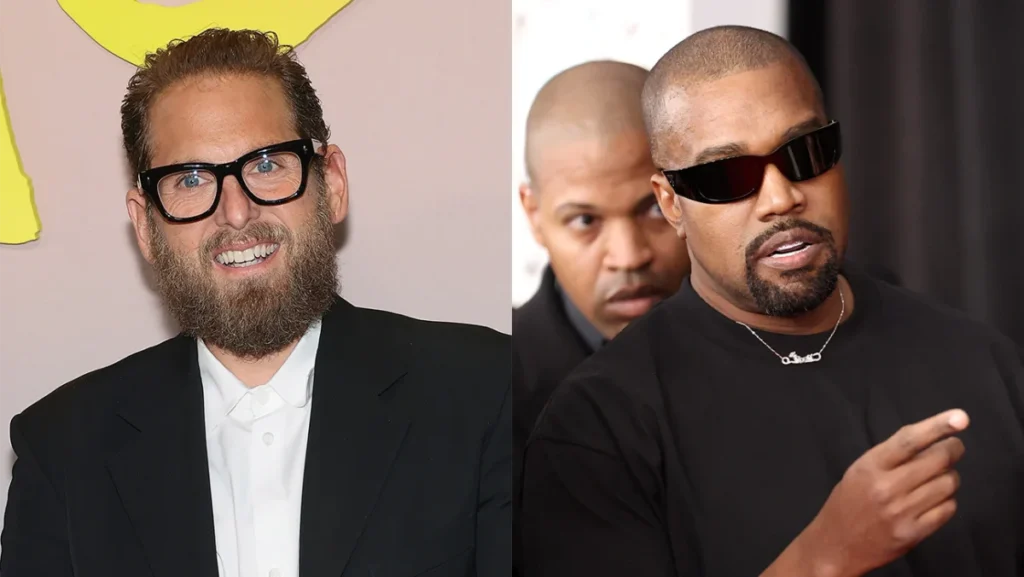

Jonah Hill’s forthcoming film Outcome is poised to ignite significant discussion with the inclusion of a provocative joke directly referencing Kanye "Ye" West and his history of antisemitic remarks. The comedic jab, which sees a character in the film suggest that "hating Jews doesn’t hurt your career, it helps it" before cutting to a photograph of West, stems directly from a peculiar 2023 Instagram post by the rapper. In that post, West claimed that Hill’s performance in the film 21 Jump Street had inspired him to "like Jewish people again," a statement that the Jewish actor has since described as a "bizarre public thing." Hill, known for his nuanced comedic approach, has opened up about the joke’s origins and his complex feelings toward West, an artist he deeply admires despite the rapper’s widely condemned rhetoric and actions.
The Genesis of a Controversial Joke
The peculiar sequence of events that led to the Outcome joke began in March 2023, when Kanye West, amidst a storm of controversy surrounding his antisemitic statements, posted an image of Jonah Hill from the 2012 film 21 Jump Street on Instagram. In the accompanying caption, West wrote, "Watching Jonah Hill in 21 Jump Street made me like Jewish people again. No one should take anger against one group of people and turn it into anger towards all Jewish people." This unexpected, and to many, perplexing, declaration came after months of virulent antisemitic remarks from West, which had led to the termination of lucrative partnerships and widespread condemnation. Hill, a prominent Jewish figure in Hollywood, found himself inadvertently thrust into the rapper’s public narrative, a situation he addressed with characteristic candor.
During a recent appearance on Apple Music’s The Zane Lowe Show, Hill reflected on West’s Instagram post, stating, "I felt that he did this bizarre public thing to kind of make up, like, ‘It’s all good cause I love Jonah.’" Hill expressed a deeply conflicted view, acknowledging the gravity of West’s previous statements while also conveying a personal hope for the artist’s well-being. "It just sat with me in a way that it’s, like, all good. I love him still, and I hope whatever happens, he can heal or whatever, and everyone can heal from all that stuff. … I hope he can heal and make it right with the people he needs to make it right [with] in the Jewish community. Me and him got no beef." This statement highlights Hill’s personal stance: a desire for reconciliation and healing, coupled with a clear separation of personal grievance from the broader societal implications of West’s actions.
Kanye West’s Pattern of Antisemitism: A Troubling Timeline
To fully grasp the context of Hill’s joke, it is essential to trace the chronology of Kanye West’s public descent into antisemitism, which began in earnest in late 2022 and has continued to reverberate through the cultural landscape.
October 2022: West’s inflammatory remarks began attracting widespread attention. He posted a tweet stating he was going "death con 3 on Jewish people," a comment that led to his suspension from Twitter (now X) and Instagram. This was followed by a series of interviews where he doubled down on antisemitic conspiracy theories, including claims about Jewish control over media and finance. In an interview with Tucker Carlson, he falsely claimed that Jared Kushner, who is Jewish, brokered the Abraham Accords "to make money."
December 2022: The controversy escalated dramatically when West appeared on Alex Jones’ Infowars, where he openly praised Adolf Hitler and espoused Holocaust denial. During the interview, West declared, "I like Hitler," and asserted, "Every human being has something of value that they brought to the table, especially Hitler." He also wore a "White Lives Matter" shirt, further alienating a significant portion of his fanbase and critics. These statements led to an exodus of major brand partners, including Adidas, Gap, and Balenciaga, which severed ties, costing West billions and significantly impacting his business empire. His talent agency, CAA, also dropped him.
2023: While West made fewer public antisemitic statements, the fallout continued. The Instagram post referencing Jonah Hill and 21 Jump Street in March 2023 was widely interpreted as a clumsy and insufficient attempt at public rehabilitation, largely dismissed by anti-hate organizations and the Jewish community as failing to address the gravity of his prior remarks.
February 2024: During Super Bowl LVIII, West aired a low-budget commercial for his Yeezy brand, which notably featured individuals wearing t-shirts emblazoned with swastika-like symbols, sparking fresh outrage and accusations of insensitivity. This came despite an earlier attempt at an apology.
Early 2024: West reportedly released a song titled "Heil Hitler," further cementing concerns about his continued embrace of antisemitic themes. The precise context of this release or its widespread availability has been debated, but its existence has been cited by critics as evidence of unaddressed issues.
March 2024: Amidst ongoing criticism and calls for accountability, West published an apology for his antisemitic statements in an advertisement in The Wall Street Journal. Written in Hebrew, the apology stated, "I sincerely apologize to the Jewish community for any unintended outburst caused by my words or actions. I am committed to starting over and making amends, and my words have hurt, and I regret any pain I may have caused." However, this apology was met with skepticism by many, who pointed to his subsequent actions and the lack of a more comprehensive engagement with the Jewish community as evidence of its superficiality. The Anti-Defamation League (ADL) noted a significant rise in antisemitic incidents following West’s initial tirades, underscoring the real-world impact of his words.
The Joke’s Unveiling and Hill’s Artistic Rationale
The specific joke in Outcome is delivered when Hill’s character’s assistant declares, "We did the research and it turns out hating Jews doesn’t hurt your career, it helps it," a line immediately followed by a visual cut to a photograph of Kanye West. This juxtaposition is designed to be jarring and thought-provoking, directly challenging the notion of accountability in public life.
Hill meticulously explained his artistic rationale for including the controversial joke during his interview with Zane Lowe. He clarified that the intent was not merely to "take a shot at Kanye" but to address a complex cultural phenomenon. "I love the Kanye that I’ve met over the years. I love the artist. I think there is no artist I probably love more across any genre ever. I think he is probably the greatest artist ever to live. And he thinks that," Hill explained with a laugh, acknowledging West’s genius while simultaneously critiquing his problematic behavior. "He’s a genius, and the stuff with the hate stuff sucks. What are you going to say? It sucks, no matter who you are, to hear that. Now, do I know what’s going on? No. Am I going to punch someone while they’re down? No, of course not."
Hill framed the joke as a comedic response to West’s "wild" 21 Jump Street post, asserting his right as a comedian to engage with such absurdity. "I just put that in there like, yo, you’re going to put the 21 Jump Street poster up there and say you don’t hate Jews anymore? That’s pretty wild. I’m gonna put a picture of you saying that hating Jews helps your career. Obviously, that’s a joke on my part. It doesn’t help your career, but it’s me just having fun. I’m a comedian." His statement underscores the role of comedy in addressing uncomfortable truths and societal paradoxes.
Further elaborating on the joke’s broader message, Hill told SiriusXM’s Julia Cunningham that it also serves as a commentary on the bewildering nature of contemporary culture. "Culture’s fucking weird and it always has been and it always will be. And one of the funny things about it is like you can go on a Jew-hating tour and then sell out [SoFi Stadium]." This observation points to a perceived disconnect between public outrage and commercial consequences, a theme that has become increasingly relevant in discussions surrounding celebrity accountability.
Celebrity Accountability and Public Reception: The "Uncancelable" Phenomenon
Hill’s joke, particularly his comment about a "Jew-hating tour" leading to sold-out venues, directly addresses the ongoing debate about celebrity accountability and the phenomenon of "uncancelable" public figures. Despite the extensive backlash and financial losses incurred by his antisemitic outbursts, Kanye West has demonstrated a remarkable ability to rebound in certain sectors of the entertainment industry.
In recent months, West has successfully sold out two nights at SoFi Stadium in Inglewood, California, for concerts supporting his album Bully. This commercial success, occurring after a period of intense public condemnation, raised questions about the efficacy of "cancel culture" and the selective memory of segments of the audience. Furthermore, West is slated to headline the U.K. Wireless Festival, a booking that itself generated controversy. Several prominent sponsors, including Pepsi, withdrew their support from the festival in response to West’s inclusion. However, the festival’s managing director publicly defended the decision, urging attendees and critics alike to "offer some forgiveness and hope to him," a sentiment that encapsulates the complex and often conflicting views on how to approach figures who have engaged in hate speech.
This pattern suggests a troubling implication: that for certain artists of immense cultural stature, the commercial impact of controversial behavior may be temporary or localized. While West faced significant financial repercussions from losing major corporate sponsorships, his direct-to-consumer ventures and live performances continue to draw massive crowds. This phenomenon highlights a tension between moral condemnation and the enduring appeal of artistic output, forcing a re-evaluation of what true accountability entails in the age of digital media and passionate fan bases. It prompts a discussion on whether the public is willing to separate the art from the artist, or if the sheer force of celebrity can simply outlast public outrage.
The Role of Comedy in Cultural Commentary
Jonah Hill’s decision to integrate such a direct and pointed critique into his film underscores the enduring power of comedy as a tool for cultural commentary and social critique. In an era where public discourse is often polarized and fraught, satire offers a unique lens through which to examine uncomfortable truths. Hill, as a comedian, leverages humor not to dismiss the gravity of antisemitism but to highlight the perceived absurdity and hypocrisy of its consequences in the public sphere.
By presenting the idea that "hating Jews doesn’t hurt your career, it helps it" as a punchline, Hill uses exaggeration to expose a troubling reality: that for some high-profile figures, the repercussions of hateful rhetoric do not always equate to a complete loss of platform or commercial viability. This form of satire forces audiences to confront the dissonance between societal values and the realities of celebrity culture. It allows for a critical examination of how quickly controversies can fade from public memory or be overshadowed by artistic output, prompting questions about collective responsibility and the normalization of problematic behavior.
Hill’s nuanced approach—expressing admiration for West’s artistic genius while unequivocally condemning his antisemitism—reflects the complex ethical tightrope comedians often walk when addressing sensitive subjects. He uses his platform not to incite further division, but to provoke thought and conversation about the difficult intersections of art, morality, and public influence. His joke, therefore, transcends mere celebrity gossip; it functions as a potent piece of social commentary, inviting viewers to critically assess the state of cultural accountability.
Broader Implications for Antisemitism and Public Discourse
Jonah Hill’s joke in Outcome and the ongoing saga of Kanye West’s public career carry significant broader implications for the fight against antisemitism and the nature of public discourse. The continued commercial success of West, despite his documented history of antisemitic statements and actions, raises serious concerns among Jewish communities and anti-hate organizations. There is a fear that such instances contribute to the normalization of antisemitic rhetoric, signaling that there are few lasting consequences for those with large platforms who engage in hate speech.
The debate surrounding forgiveness versus accountability remains central. While calls for "forgiveness and hope," as expressed by the Wireless Festival director, speak to a desire for redemption, many argue that true forgiveness can only follow genuine, sustained accountability and a demonstrable commitment to making amends. Superficial apologies or continued problematic behavior undermine the sincerity of such gestures, leading to cynicism and further distress for those targeted by hate.
Ultimately, Hill’s provocative joke serves as a cultural mirror, reflecting the complexities and contradictions inherent in contemporary society’s engagement with celebrity, hate speech, and artistic freedom. It underscores the immense influence celebrities wield in shaping public opinion and the ongoing challenge of holding powerful figures responsible for their words and actions, particularly when their artistic output continues to command a devoted following. As Outcome prepares for release, it is clear that Hill’s comedic intervention will contribute to a necessary and ongoing dialogue about the boundaries of acceptable public discourse and the true cost of hate.