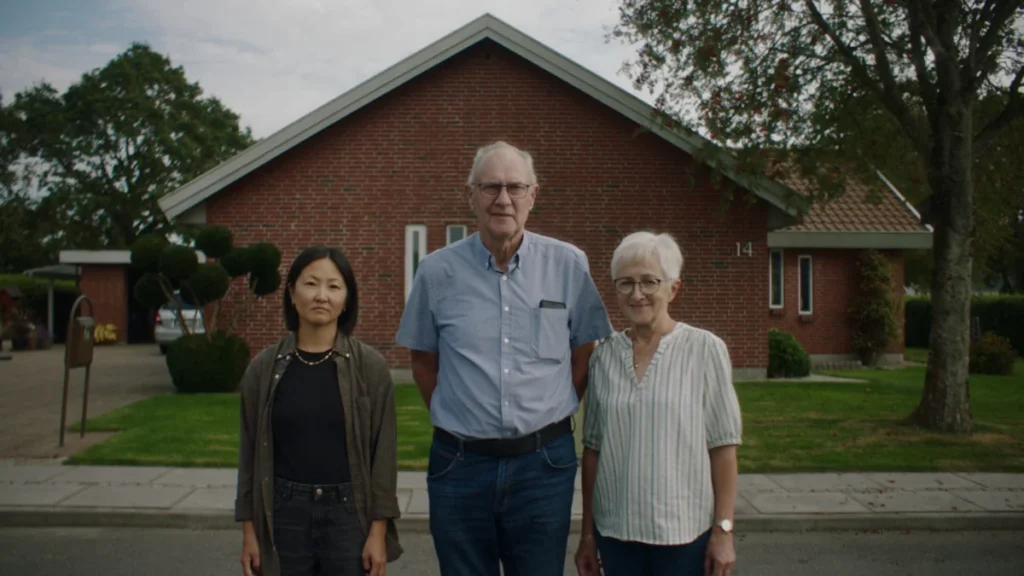

Director Taekyung Tanja Inwol’s second feature documentary, Homesick (Hjemsøgt), compels audiences to confront profound questions surrounding the essence of family, the meaning of home, and the arbitrary nature of belonging, all while dissecting the complex and often painful realities of transnational adoption. The film, which world premiered in the prestigious NORDIC:DOX competition at the 23rd edition of CPH:DOX, the Copenhagen International Documentary Film Festival, has been lauded as "a raw family chronicle" traversing the geographical and emotional expanse between Western Denmark and South Korea. It meticulously unravels the director’s personal narrative as an adoptee from South Korea, exposing the hidden traumas within her adoptive family and the systemic failures of a global adoption industry.
The Unveiling of a Fractured Reality
The core of Homesick delves into the stark contrast between appearances and reality within Inwol’s adoptive Danish family. A synopsis for the film starkly highlights, "In Taekyung’s family in Denmark, everything was meant to look perfect on the surface, but behind the façade, there was domestic violence, breakups, divorce, suicide attempts, death, loneliness, and much more." This unsettling revelation serves as a poignant backdrop to the film’s central query: when one’s origins have been systematically erased in Korea, where does an individual turn when the very family one has been placed in begins to fracture under the weight of its own hidden sorrows?
This deeply personal quest takes on a broader, urgent political dimension with the inclusion of a critical development from June 2025. At this time, the Korean Truth and Reconciliation Commission (TRC) concluded its investigation into Inwol’s adoption case, finding it among a cohort of 56 cases where egregious human rights violations occurred. Specifically, the TRC determined that Inwol’s original documents had been falsified, fabricating her status as a "foundling" – a common practice designed to expedite adoptions for profit. This deliberate misrepresentation streamlined the process, making children appear more readily adoptable, often obscuring their true identities and family histories. Despite these damning findings by an official body, the film underscores the painful reality that such conclusions have, to date, failed to yield concrete action from either the Korean or Danish states, leaving Inwol without access to vital information about her birth parents.
A History of Transnational Adoption from South Korea
To fully grasp the context of Inwol’s experience, it is essential to understand the historical trajectory of South Korea’s international adoption program, which has sent more children abroad than any other country. Beginning in the aftermath of the Korean War (1950-1953), the program initially focused on war orphans and mixed-race children, often stigmatized in a homogenous society. However, as the nation industrialized and poverty persisted, particularly in the 1970s and 1980s, the scope expanded to include children from single mothers, impoverished families, or those deemed "undesirable" by societal norms.
During its peak in the late 1970s and early 1980s, South Korea was sending over 8,000 children annually to Western countries, primarily the United States, but also significant numbers to European nations like Denmark, Sweden, and Norway. Over 200,000 Korean children have been adopted internationally since the 1950s. This era saw the rise of powerful adoption agencies, both Korean and international, which often operated with minimal oversight, facilitating a system that critics have since termed the "adoption industrial complex." Profit motives, coupled with societal pressures and sometimes coercive practices against birth mothers, contributed to a fertile ground for irregularities and human rights abuses, including the falsification of documents, as highlighted by Inwol’s case. The narrative of the "foundling" became a convenient, if often untrue, label to bypass legal complexities and accelerate adoptions, effectively erasing a child’s true origins and severing their connection to their biological family and heritage.
The Role of the Truth and Reconciliation Commission
The Korean Truth and Reconciliation Commission (TRC), established in 2020, represents a significant step by South Korea to confront its painful past. Its mandate extends to investigating human rights abuses, past atrocities, and historical events that have caused suffering to individuals. While its initial focus included state violence and massacres, the TRC expanded its scope to include international adoption cases following sustained advocacy from adoptee groups and human rights organizations.

The specific findings in June 2025 regarding Inwol’s case, alongside 55 others, represent a landmark acknowledgment by a state entity of systemic violations within the adoption process. The TRC’s investigations have meticulously unearthed patterns of document falsification, identity manipulation, and procedural irregularities that prioritize the needs of adoptive parents and agencies over the fundamental rights of the child and birth family. These findings validate the long-held suspicions and experiences of countless adoptees who have grappled with incomplete or contradictory personal histories. However, as Homesick powerfully illustrates, the identification of wrongdoing is only the first step. The subsequent challenge lies in securing accountability, providing reparations, and, crucially, facilitating access to accurate information for adoptees seeking their biological roots. The silence from the Korean and Danish states post-TRC findings underscores the immense political and diplomatic complexities involved in rectifying historical injustices across international borders.
A Director’s Artistic and Personal Journey
Inwol employs a rich tapestry of interviews, archival photographs, evocative landscapes, and introspective voice-overs to construct her experience. The press notes for the documentary emphasize her dual identity: "as the only adoptee in a Danish family and as someone who has been erased from Korea her entire life." The film skillfully interweaves "personal memories and imagination with the political realities of a transnational adoption system that long ago lost its shine," presenting a narrative that is both deeply intimate and broadly critical.
The motivation behind Homesick is rooted in Inwol’s profound personal history. She explains, "I have, as a child, had more families than most, belonged to many and nowhere at all — but the premise for them all was that someone had the power to decide where and to whom I was allowed to belong." This sentiment encapsulates the power imbalance inherent in transnational adoption, where the agency of the child is entirely absent. She challenges societal norms by questioning the parameters used to determine a "better" family: "By what parameters can one even determine whether one family is better than another? The childless couple in the West Danish town of Varde had more right to a child than the single mother in the Korean port city of Incheon. Not just any child — but the child she had given birth to. In this way, a child born in Korea grew up in Denmark. Isn’t it strange that the child grows up in a random family on the other side of the world — and no one talks about it." This observation cuts to the heart of the film’s critique, highlighting the collective silence that often shrouds the ethical ambiguities of such practices.
The catalyst for embarking on this cinematic journey was the death of Inwol’s parents. This pivotal event unlocked a need to process her emotions and unanswered questions. "You know this whole thing about rest in peace?" she shared with THR. "People have this idea: let’s not speak ill of the dead. But I was like: ‘No, now’s the time to talk about all the stuff that we couldn’t talk about before.’ It was too difficult when they were alive. Nobody seemed to really agree with me, but I just had all these questions."
Initially, the film was not intended as a self-portrait. "The idea was to make a film about all the things that we don’t talk about in the family," Inwol explained. "I wanted to create a visual language for the things for which a language doesn’t exist." However, as she began interviewing family members, a realization dawned: "I realized that I was part of the secrets. So, I thought, okay, well, I guess it will have to be a film about me, or at least from my position in the family, as being one who we don’t talk about." What began as an investigative project ultimately transformed into a deeply personal quest for self-healing, evolving into a monumental undertaking far beyond her initial intentions.
Homesick is not Inwol’s first foray into exploring complex familial dynamics. Her debut feature, A Colombian Family, delved into the healing process between a mother and daughter in Colombia, showcasing a clear thematic thread in her work. "You can see a trend here," Inwol quipped, acknowledging the underlying personal resonance. "I realized that the reason why I made that film was so that I could mirror myself in their relationship." This consistent focus on fractured families, identity, and healing underscores a directorial voice deeply committed to understanding the human experience within challenging relational contexts.
The Challenges of Being Both Director and Subject
Navigating the dual roles of director and protagonist presented unique challenges for Inwol. "It was never my wish to be a protagonist in my own film. So, when I started out making it, it was so important for me to have control over how I was presented and what people were allowed to see," she told THR. While being both filmmaker and subject afforded her ultimate control, it necessitated a strict set of self-imposed rules to manage her narrative and public presentation. "How do I keep control of the narrative, and how do I present the world through my gaze?"
One of the significant hurdles she identified was the absence of a societal language to articulate her unique experience. "There is just no language for difference, and so I had to [think about] how to give myself that language," she recalled. Furthermore, Inwol was acutely aware of potential audience biases. "And I am also very aware that the audience is not necessarily on my side, because I’m the minority in the story. So, how do I turn the gaze around? It means I had to make up a gaze. They have never seen my gaze on them." This intention to reverse the conventional gaze – to make the majority understand the perspective of the minority – is a powerful artistic and political statement embedded within the film’s fabric.

Visual Storytelling and Symbolism
Inwol employs distinct visual motifs to convey her complex narrative. One recurring element is footage depicting her standing alongside other individuals, whose identities are not immediately revealed, in a composition reminiscent of traditional family photographs. Inwol refers to these as "moving portraits." "Because it’s as if you take a portrait, but then just keep it going," she explained. "This is the first moment that you get to meet these people, because these people are both family, but also somebody who I want to invite the viewer to look at. Putting myself next to them means you cannot tell from that shot alone whether it’s my parents or my brother or whoever. And I think that just shows the randomness of it all. So, by introducing them in that way next to me, it gives you the idea of the randomness of my being there." This visual strategy subtly underscores the arbitrary nature of her placement within her adoptive family and the broader, often random, outcomes of the adoption system.
Another powerful visual element features performative scenes in Korea, where Inwol and three friends, all adopted from Korea to Denmark, wear the traditional Korean hanbok. "The other three women that I walk with are also adopted from Korea to Denmark," Inwol elaborated. "And the idea for me was to show that I’m not alone, although the core feeling in the film is loneliness and not being seen or recognized." These scenes are crucial for creating "a sense of community" amidst the pervasive theme of isolation. The hanbok, in this context, transcends mere traditional attire; it symbolizes resilience, resistance, and a reclaiming of cultural identity in the face of an "erased" past. It also subtly acknowledges Korea as "a nation suffering" from the historical implications of its adoption policies, while simultaneously celebrating the enduring spirit of its diaspora.
Broader Implications and the Path Forward
Homesick transcends a personal memoir, serving as a critical examination of global adoption practices and their lasting human cost. The film’s findings, supported by the TRC’s conclusions, contribute to a growing international discourse demanding greater accountability from adoption agencies and states involved in transnational adoptions. The lack of concrete action from the Korean and Danish governments, despite official acknowledgment of human rights violations, highlights systemic inertia and the formidable challenges adoptees face in seeking justice, information, and connection to their origins. Advocacy groups worldwide continue to press for comprehensive reform, including transparent record-keeping, robust ethical guidelines, and support for adoptees seeking reunification with birth families.
The film’s exploration of identity, trauma, and belonging resonates far beyond the adoptee community, touching upon universal human experiences of seeking connection and understanding one’s place in the world. It challenges viewers to reconsider simplistic narratives surrounding adoption, urging a deeper empathy for the complex emotional landscapes adoptees navigate. In a broader sense, Homesick contributes to the evolving understanding of family not merely as a biological construct, but as a fluid, sometimes fractured, entity shaped by historical, political, and personal forces.
Future Endeavors
Inwol’s directorial vision continues to be guided by these profound themes. "There’s a red thread through my films, and that is the theme of family divided by conflict or war or diaspora experiences," she highlighted. Her next project, currently in early development, will focus on one of the oldest Korean communities in Mexico. "For me, it would be nice because it touches on themes I know. I constantly ask myself, ‘What films can I make? What films are for me?’" This ongoing exploration promises further poignant narratives that illuminate the enduring impact of displacement and the resilience of the human spirit in forging identity across geographical and cultural divides.
Homesick stands as a powerful testament to the courage of individuals to confront painful truths and to the transformative power of filmmaking as a tool for healing, advocacy, and social change. Its premiere at CPH:DOX marks a significant moment in the ongoing conversation about transnational adoption, urging audiences and policymakers alike to look beyond the surface and acknowledge the profound human stories that lie beneath.
Producers for Homesick include Rikke Tambo Andersen, Sona Jo, and Virpi Suutari. Catherine Pattinama Coleman and Mathias Døcker served as cinematographers, with editing by Matilda Henningsson. Impronta Film is handling international sales for the Tambo Film production.