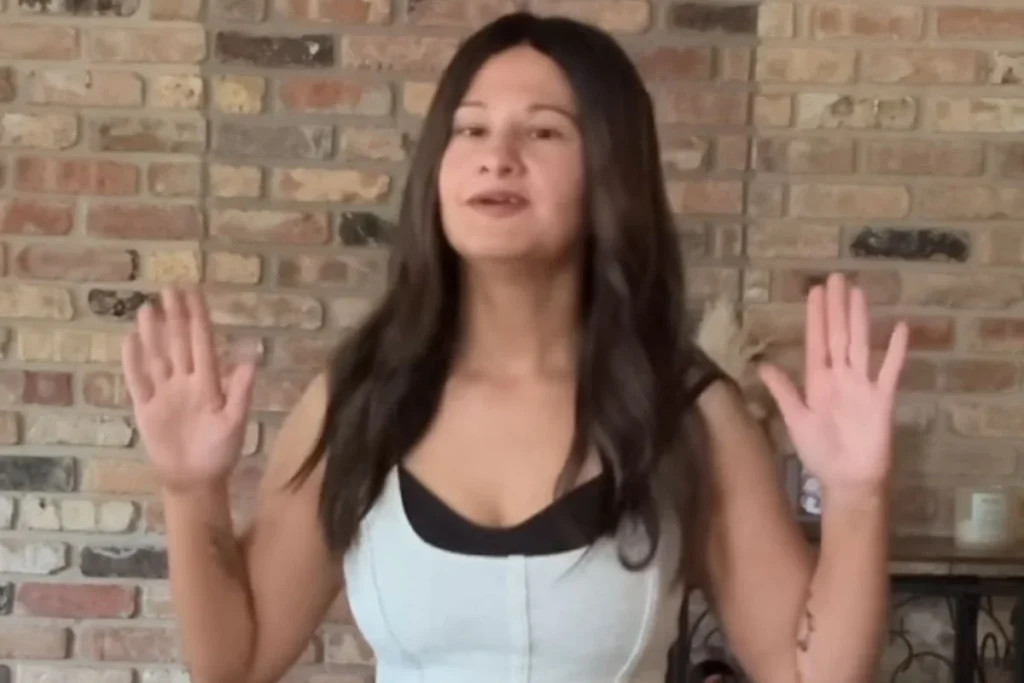

Gypsy Rose Blanchard, a figure synonymous with one of the most compelling and tragic true crime stories of the 21st century, has once again found herself at the epicenter of public scrutiny following a controversial statement made in a recent TikTok video. The former inmate, whose life story involves severe child abuse, Munchausen by Proxy, and ultimately the murder of her mother, Dee Dee Blanchard, made a comment referencing her past crime that has ignited a firestorm of criticism across social media platforms.
The incident unfolded over the past weekend when Blanchard appeared in a TikTok video shared on the page of influencer Natalie Reynolds. The duo was participating in a trending online challenge known as "we listen and we don’t judge," where participants confess personal truths or past actions, with the implicit understanding that the audience is to refrain from casting judgment. While Reynolds admitted to unconventional habits and a past deception involving a fake pregnancy, and Blanchard spoke of wearing wigs due to bleached hair, the mood shifted dramatically when Blanchard addressed her most infamous act.
With an unsettlingly casual demeanor, Gypsy Rose Blanchard stated, "We listen and we don’t judge. I went to prison for eight and a half years because I [killed] my own mom." The revelation was met with a visibly shocked expression from Natalie Reynolds, whose eyes widened in disbelief. Blanchard, seemingly unperturbed by Reynolds’ reaction or the gravity of her own words, simply reiterated the challenge’s premise: "Hey, we listen and we don’t judge!" The video quickly circulated, drawing immediate and widespread condemnation from viewers who found the statement profoundly insensitive and disturbing.
Public Outcry and Social Media Scrutiny
The immediate aftermath of the TikTok video’s release saw an explosion of critical comments across various social media platforms. Users expressed a range of emotions, from shock and disgust to accusations of insensitivity and a perceived lack of remorse. Comments such as "We listen and we call a judge," "So, this is a confession right??" and "wtf we all judging" flooded the comment sections, underscoring the public’s unwillingness to adhere to the video’s "no judgment" premise when confronted with such a statement. Many viewers highlighted the ethical boundaries crossed, with remarks like "nothing funny about this at all," "That wasn’t cute nor funny smh," and "there’s absolutely nothing funny in this, this is actually so freaking wrong." The casual delivery of the statement by Blanchard particularly unnerved many, leading to comments like "She said it too casually." Others voiced concern for potential future implications, questioning, "Imagine her daughter watching this one day?" and revisiting the legal aspect with "Did she just admit it?" The overwhelming sentiment indicated that for many, the severity of the crime and the context of her mother’s abuse precluded any attempt at dark humor.
The incident quickly became a trending topic, illustrating the power of social media to amplify controversial content and shape public discourse around complex figures. While some online discussions attempted to contextualize Blanchard’s statement within her traumatic past, the prevailing sentiment was one of strong disapproval, highlighting the delicate balance between personal expression, public perception, and the gravity of past actions, particularly those involving violent crime.
The Deep-Seated History: The Case of Dee Dee and Gypsy Rose Blanchard
To understand the intensity of the public reaction, one must delve into the harrowing details of the Blanchard case, which captivated the nation and sparked extensive discussions about child abuse, mental illness, and the boundaries of justice.
Munchausen by Proxy and Years of Deception:
The story of Gypsy Rose Blanchard is inextricably linked to the severe and systematic abuse inflicted upon her by her mother, Clauddine "Dee Dee" Blanchard. Dee Dee suffered from Munchausen syndrome by proxy (now known as Factitious Disorder Imposed on Another, or FDIA), a rare mental disorder where a caregiver fabricates or induces illness in a person under their care, often a child, for attention or sympathy. For nearly two decades, Dee Dee convinced doctors, family, friends, and the public that Gypsy suffered from a litany of severe chronic illnesses, including leukemia, muscular dystrophy, epilepsy, severe asthma, sleep apnea, and various developmental delays.
This elaborate deception involved shaving Gypsy’s head to simulate chemotherapy, forcing her to use a wheelchair despite her ability to walk, administering unnecessary medications, and subjecting her to countless medical procedures, surgeries, and hospitalizations, many of which were invasive and traumatic. Gypsy was fed through a feeding tube she didn’t need and was prescribed powerful narcotics. Dee Dee expertly manipulated medical professionals, often moving to different states to avoid suspicion and ensure her narrative remained unchallenged. The pair received significant charitable donations, free trips, and a custom-built home from Habitat for Humanity, all predicated on Gypsy’s fabricated ailments. Gypsy was isolated from other children and homeschooling was used as another means of control, further limiting her exposure to outside perspectives.
The Murder Plot and Its Execution:
As Gypsy grew older, she began to realize the extent of her mother’s deception and her own physical capabilities. Her desire for independence and freedom intensified, clashing violently with Dee Dee’s suffocating control. In 2012, Gypsy attempted to run away with a man she met at a science fiction convention, but Dee Dee found her and brought her back, reinforcing her control by smashing Gypsy’s computer and tying her to a bed.
Desperate to escape, Gypsy sought solace online, where she met Nicholas Godejohn on a Christian dating site. Their relationship, initially conducted through text and chat, quickly evolved. Gypsy confided in Godejohn about the abuse, and together, they devised a plan to kill Dee Dee. The motive, from Gypsy’s perspective, was to free herself from a life of medical torture and imprisonment.
On June 14, 2015, Godejohn traveled from Wisconsin to the Blanchard home in Aurora, Missouri. While Gypsy hid in the bathroom, Godejohn stabbed Dee Dee Blanchard to death. The couple then fled, taking some money and Dee Dee’s laptop, and posted a chilling message on Dee Dee’s Facebook page, which ultimately led to their discovery and arrest.
Legal Proceedings and Sentencing
The murder of Dee Dee Blanchard and the subsequent unraveling of the years of abuse sent shockwaves through the community and captured national attention. The legal proceedings that followed sought to untangle the complex web of culpability, abuse, and desperation.
Gypsy Rose Blanchard’s Plea:
In July 2016, Gypsy Rose Blanchard pleaded guilty to second-degree murder. Her defense argued that she was a victim of severe child abuse, suffering from the psychological effects of her mother’s Munchausen by Proxy. Prosecutors, acknowledging the unique circumstances of the case and the extensive documentation of abuse, agreed to a plea deal. Gypsy was sentenced to 10 years in prison, with eligibility for parole after serving 85% of her sentence. The judge’s decision reflected a recognition of the profound psychological coercion and physical abuse Gypsy endured, framing her actions as a desperate attempt to escape a life of torment. She was imprisoned from 2015 to 2023.
Nicholas Godejohn’s Conviction:
Nicholas Godejohn, Gypsy’s then-boyfriend, faced a separate trial. In November 2018, he was found guilty of first-degree murder. His defense attempted to argue that he acted at Gypsy’s behest and suffered from developmental disabilities, making him susceptible to manipulation. However, the jury determined that he intentionally and premeditatedly killed Dee Dee Blanchard. He was subsequently sentenced to life in prison without the possibility of parole for first-degree murder, with an additional 25 years for armed criminal action due to his use of a knife during the murder. The stark difference in sentences highlighted the court’s assessment of their respective roles and levels of culpability, with Godejohn bearing the primary legal responsibility for the physical act of murder.
Life After Lockup: Gypsy Rose’s Re-entry into Public Life
Gypsy Rose Blanchard’s release from Chillicothe Correctional Center in Missouri on December 28, 2023, marked a new chapter in her extraordinary life. Her story, already extensively documented in HBO’s "Mommy Dead and Dearest" and Hulu’s "The Act," continued to fascinate the public.
A Newfound Celebrity and Media Presence:
Upon her release, Blanchard was met with a level of public interest typically reserved for celebrities. She quickly amassed millions of followers on social media platforms like TikTok and Instagram, leveraging her story to build a significant online presence. She engaged with fans, shared insights into her new life, and promoted her book, "Released: Conversations on the Eve of Freedom," which offered her personal account of the events. Her journey was further chronicled in the Lifetime docuseries "The Prison Confessions of Gypsy Rose Blanchard," providing a platform for her to share her perspective directly with a wide audience.
Her post-release life has been a whirlwind of media appearances, interviews, and public engagements. She married Ryan Scott Anderson while in prison, and their relationship became a focal point of her early freedom, though they have since announced their separation and subsequent divorce filing. This period has seen her attempt to redefine her narrative, moving beyond the victim and perpetrator labels to embrace a more nuanced identity.
Navigating Fame and Trauma:
However, Blanchard’s rapid ascent to social media fame has not been without its challenges. She faces the complex task of navigating a public life while processing years of trauma and the weight of her past actions. The public’s perception of her is often split: some view her as a survivor deserving of empathy and a second chance, while others grapple with the fact that she orchestrated a murder, regardless of the abuse she suffered. Her public statements and actions are constantly scrutinized, often re-igniting debates about justice, accountability, and the ethics of profiting from a crime, even one committed under duress.
Analysis of the TikTok Controversy
The recent TikTok video featuring Gypsy Rose Blanchard’s joke about killing her mother has reopened these complex discussions, pushing them into the realm of social media ethics and celebrity responsibility.
Ethical Considerations of Content Creation:
The incident highlights the fine line between dark humor and outright insensitivity, especially when dealing with deeply traumatic events and violent crime. While some may argue for artistic freedom or the right to express oneself through humor, the public reaction demonstrates that certain topics, particularly those involving murder and severe abuse, carry such gravity that attempts at levity can be perceived as profoundly disrespectful and disturbing. For many, a joke about killing one’s mother, regardless of the circumstances, crosses a moral boundary, particularly from someone who directly participated in such an act.
The Role of Influencers and Platforms:
Natalie Reynolds, as the host and fellow participant in the video, also drew criticism for her involvement. The incident raises questions about the responsibility of social media influencers to curate content that is not only engaging but also ethically sound. Social media platforms themselves face ongoing challenges in moderating content that pushes boundaries, balancing free expression with the potential for harm or offense. The rapid spread of the video and the intense backlash demonstrate the collective power of online communities to police perceived transgressions.
Public Perception vs. Personal Narrative:
Gypsy Rose Blanchard has been actively working to control her narrative since her release, often portraying herself as a survivor who has paid her debt to society and is moving forward. This TikTok joke, however, appears to have undermined those efforts for many, reigniting skepticism about her sincerity or her understanding of the gravity of her past actions. It suggests a potential disconnect between her personal coping mechanisms (possibly using humor to process trauma) and public expectations for how someone involved in such a crime should behave or speak.
Trauma and Expression:
From a psychological perspective, individuals who have experienced severe trauma may develop complex coping mechanisms, including dark humor or a casualization of past events, as a way to process or distance themselves from pain. However, when these expressions occur in a highly public forum, they are subject to interpretation by an audience that does not share the same lived experience. While this context might offer some explanation for Blanchard’s behavior, it does not negate the impact of her words on the wider public, many of whom feel a deep moral offense. The public’s reaction reflects a broader societal expectation that serious crimes, even those with mitigating circumstances, warrant a degree of solemnity and a clear demonstration of remorse.
Broader Implications
The controversy surrounding Gypsy Rose Blanchard’s TikTok video extends beyond her individual actions, touching upon several broader societal implications.
The "True Crime" Phenomenon and Ethics:
The Blanchard case is a prime example of the pervasive "true crime" phenomenon, where real-life tragedies are consumed as entertainment. This incident highlights the ethical dilemmas inherent in this genre, particularly when the subjects of these stories become public figures. It raises questions about the responsibility of the media, content creators, and the audience in engaging with individuals whose lives are intertwined with severe trauma and violent crime. Is it ethical for individuals to profit from their criminal past, even if they were victims of abuse? How should society balance sympathy for a victim with accountability for their actions?
Social Media’s Impact on Public Figures:
For individuals like Blanchard, social media offers a direct conduit to connect with an audience, share their story, and build a new life. However, it also presents a minefield of potential missteps. Every statement, every video, is subject to immediate and often unforgiving public judgment. The incident underscores the challenges public figures face in navigating the digital landscape, where the line between private expression and public persona is often blurred, and past actions are perpetually accessible and open to re-examination.
The Challenge of Rehabilitation and Reintegration:
The public’s intense reaction also reflects ongoing societal struggles with concepts of rehabilitation and reintegration for individuals who have committed serious offenses. While Gypsy Rose Blanchard served her time and was legally released, the moral judgment of society often lingers, particularly when past actions are seemingly trivialized. Her journey continues to test the boundaries of forgiveness, understanding, and the capacity for individuals to move past their darkest chapters.
In conclusion, Gypsy Rose Blanchard’s recent TikTok video, intended as a casual confession within an online challenge, has inadvertently reignited profound public debates. It underscores the enduring complexity of her story, the ethical tightropes walked by public figures with controversial pasts, and the powerful, often unforgiving, nature of social media as a platform for expression and judgment. As Blanchard continues to navigate her life after lockup, her every public move will likely remain under intense scrutiny, serving as a continuous case study in trauma, justice, and the evolving landscape of public morality in the digital age.