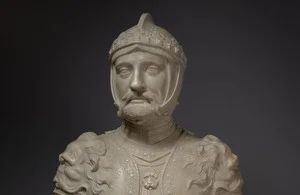

The United Kingdom government has placed a temporary export restriction on a significant 18th-century marble sculpture depicting Edward of Woodstock, widely known to history as the Black Prince. This administrative measure aims to provide British cultural institutions, museums, and galleries a vital window of opportunity to raise the necessary capital to acquire the artwork and secure its permanent residency within the country. Valued at nearly half a million pounds, the sculpture holds a dual historical significance: it represents one of the most celebrated medieval military commanders of the Plantagenet dynasty, and it serves as a masterwork by one of Georgian Britain’s most esteemed sculptors, Michael Rysbrack.
The statutory export bar, announced by the Department for Culture, Media and Sport (DCMS), prevents the artwork from being exported overseas by a private international buyer. The initial restriction period runs until February 5, 2027. During this timeframe, domestic public collections have the chance to match the recommended purchase price of £496,044.51, plus VAT, bringing the total acquisition cost to upwards of £500,000. If a recognized UK institution steps forward with a credible fundraising campaign or sufficient acquisition funds, the permanent loss of this cultural asset to an overseas buyer can be averted.
The Legacy of Edward of Woodstock: The Medieval Context
To understand the cultural weight of the Rysbrack sculpture, one must examine the life and legacy of the man it portrays. Edward of Woodstock was born in June 1330 at Woodstock Palace in Oxfordshire, the eldest son of King Edward III and Queen Philippa of Hainault. As the primary heir to the English throne from his infancy until his untimely death, he occupied a central position in the geopolitical landscape of fourteenth-century Europe. Although he never ascended to the throne due to predeceasing his father by a single year—leaving the crown to his young son, who would become King Richard II—his impact on English history was profound.
Edward achieved legendary status as one of the preeminent military commanders of the Hundred Years War. He played a decisive tactical role in major English victories, most notably commanding the vanguard at the Battle of Crecy in 1346 at the tender age of sixteen, and later securing a stunning triumph at the Battle of Poitiers in 1356, where he captured the King of France. These military exploits cemented his reputation as the epitome of medieval chivalry, a status further burnished by his contemporary chroniclers, such as Jean Froissart.
Despite his military brilliance, Edward’s life was also marked by personal drama, including his controversial marriage to his cousin Joan of Kent, a union driven by mutual affection rather than straightforward political alliance. Though popular myth often attributes his famous moniker, "The Black Prince," to a dark suit of armor he allegedly wore in battle, historians note that the nickname did not appear in contemporary chronicles during his lifetime and only gained widespread usage centuries after his death. Nonetheless, the persona of the Black Prince became an archetype of English martial prowess and chivalric virtue.
Georgian Patronage and the Artistry of Michael Rysbrack
The marble bust subject to the current government intervention was not crafted during the medieval era in which Edward lived, but rather centuries later during the Georgian period. In 1735, Frederick, Prince of Wales, commissioned the work from the celebrated Flemish-born sculptor Michael Rysbrack.
Frederick, Prince of Wales, found himself in a familial and political situation remarkably parallel to that of the Black Prince. Having become heir apparent in 1727 following the ascension of his father, King George II, Frederick spent decades awaiting a crown that he would ultimately never wear. He predeceased his father in 1751, meaning the British crown passed directly to Frederick’s eldest son, who ascended as King George III.
Seeking to draw a direct line of legitimacy and historical continuity between the House of Hanover and the great military heroes of England’s medieval past, Frederick turned to Michael Rysbrack. At the time, Rysbrack was widely regarded as the preeminent sculptor working in Britain. Known for introducing a sophisticated, classicizing style that revolutionized British portraiture and monumental sculpture, Rysbrack was uniquely equipped to forge a visual vocabulary for the Georgian court.
The resulting marble bust of the Black Prince was a masterclass in dynastic self-fashioning. By commissioning a likeness of Edward of Woodstock, Frederick, Prince of Wales, sought to align his own public image with the chivalry, military glory, and patriotic legacy of his medieval predecessor. In the nearly three centuries since its creation, Rysbrack’s bust has achieved an extraordinary status: it has served as the foundational visual template for almost every subsequent artistic representation of the Black Prince, fundamentally shaping the public imagination regarding what the legendary medieval prince looked like.
Official Responses and the RCEWA Assessment
The decision to impose the export bar was taken following the advice of the Reviewing Committee on the Export of Works of Art and Objects of Cultural Interest (RCEWA). The committee evaluates applications for export licenses for cultural goods to determine whether they meet the criteria known as the Waverley criteria—specifically, whether an object is so closely connected with British history and national life that its departure would constitute a misfortune, whether it is of outstanding aesthetic importance, and whether it is vital for the study of a particular branch of art, history, or science.
Stuart Lochhead, a member of the RCEWA, emphasized the immense historical and artistic value of the sculpture during the announcement of the export restriction. "Michael Rysbrack was one of the most important sculptors of eighteenth-century Britain, developing a classicising style that established a new taste for portraiture, monuments, and statuary," Lochhead stated. "This handsome marble bust of Edward, the Black Prince, served a particular purpose for Georgian patrons and the royal court, who used such portraits for dynastic and patriotic self-fashioning, aligning themselves with a lineage of English kingship and chivalric virtue that would define imagery for generations."
Lochhead further underscored the rarity of the artifact, noting that it stands as one of the finest and earliest known works of its specific genre. Consequently, its permanent removal from the United Kingdom would represent a tangible loss to academic scholarship and a diminished capacity to understand the complex cultural mechanisms of Georgian society.
Echoing these sentiments, Heritage Minister Baroness Twycroft highlighted the enduring cultural resonance of the sculpture in contemporary British life. "This striking sculpture of Edward the Black Prince still defines how we imagine this legendary figure in British history," Baroness Twycroft remarked. "For nearly three hundred years it has shaped how we tell the story of our medieval history and I hope that in a public gallery in the UK it can tell that story much more powerfully for many more years to come."
Economic and Logistical Implications for UK Institutions
The implementation of the export bar initiates a high-stakes race against time for British galleries, museums, and heritage trusts. With a baseline price tag of £496,044.51 plus VAT, the acquisition cost presents a formidable hurdle for cultural organizations operating amid ongoing fiscal constraints and reduced public funding endowments.
Securing funds in excess of half a million pounds typically requires a coordinated effort involving major grant-giving bodies such as the National Heritage Memorial Fund (NHMF), the Art Fund, and private philanthropic donations. Institutions have until February 5, 2027, to demonstrate that they can raise the necessary capital, though the Department for Culture, Media and Sport holds the discretionary power to extend this deadline if a serious fundraising campaign is demonstrably underway and showing positive momentum.
Should a domestic institution successfully acquire the bust, it will likely enter a public gallery collection where it can be studied not only as a portrait of a medieval icon, but also as a fascinating artifact of eighteenth-century political culture and royal propaganda. Conversely, if the funding target is not met by the deadline, the export bar will lapse, permitting the buyer to export the sculpture to an international collection, effectively removing a cornerstone of British royal iconography from domestic public access.
Interested public galleries, museums, and qualified British heritage organizations seeking to explore acquisition possibilities are instructed to direct their inquiries to the Reviewing Committee on the Export of Works of Art and Objects of Cultural Interest via the Arts Council England administrative channel at [email protected].