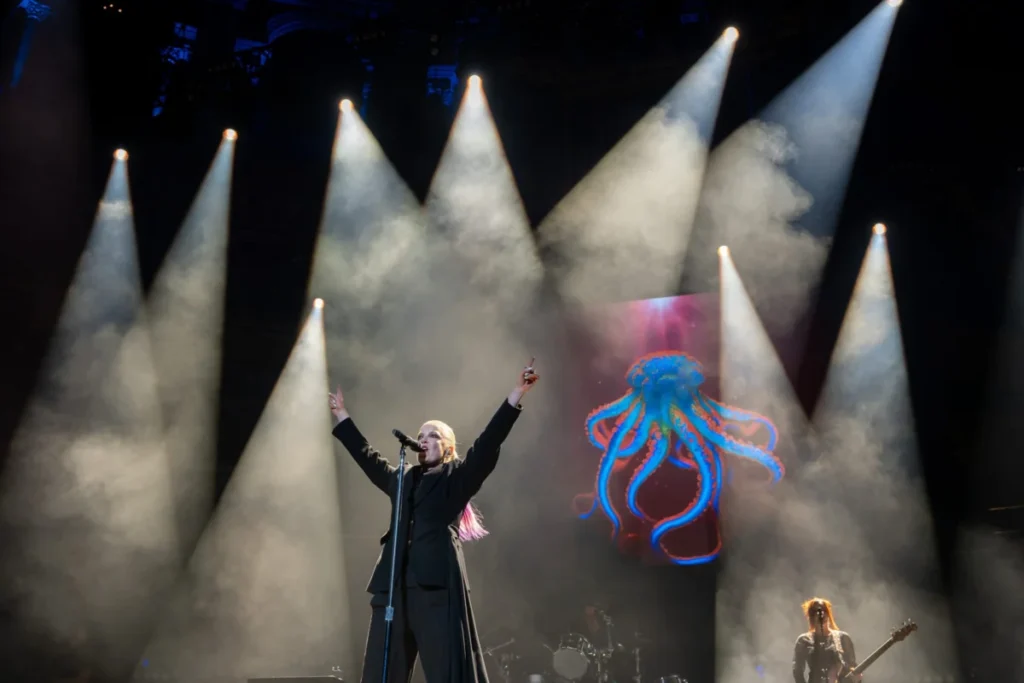

The Royal Albert Hall, London’s iconic cultural landmark, vibrated with a potent blend of alternative rock and impassioned social commentary this past Saturday as Garbage, fronted by the indomitable Shirley Manson, delivered a headlining performance as part of the annual Teenage Cancer Trust concert series. Preceded by a rapturously received set from Placebo, the evening was a testament to music’s power to entertain, inspire, and advocate, all while raising crucial funds for a vital cause. The series itself, curated this year by The Cure’s legendary frontman Robert Smith, has seen a week of exceptional talent gracing the prestigious stage, underscoring the profound influence of British alternative music.
Garbage’s Emotional Tribute and Activist Anthem
Garbage’s set was a masterclass in raw emotion and high-octane performance, deeply intertwined with personal reflections and sharp socio-political commentary. A standout moment arrived early in their performance when Shirley Manson announced a spontaneous cover of The Cure’s seminal 1989 single, "Lovesong." She revealed that the band had "never played the 1989 single before but had whipped it up in tribute to The Cure and the great Robert Smith, who asked us to play tonight." The rendition was not merely a musical homage but a deeply personal one for Manson, who confessed her hope to get through the song "without crying." Following the performance, visibly moved, she described it as a "bucket list moment," singing "in this insanely beautiful building" a song penned by the very artists who had inspired her to embark on her own musical journey. This poignant tribute resonated deeply, highlighting the generational impact of bands like The Cure on the alternative music landscape and the profound respect held by contemporary artists for their forebears.
The choice of "Lovesong," a track renowned for its melancholic beauty and lyrical depth, served as a powerful counterpoint to the raw energy of Garbage’s own catalogue. It wasn’t just a cover; it was an acknowledgment of a shared musical lineage, a moment of reverence from one influential band to another. The atmosphere in the Royal Albert Hall was palpable, a collective sense of witnessing a rare and heartfelt artistic exchange.

Manson, clad appropriately and strikingly all in black, commanded the stage with an unyielding energy that belied her emotional vulnerability. Her performance was not confined to the traditional stage area; she repeatedly ventured into the grand architectural expanse of the Royal Albert Hall, climbing the stairs on both sides, at one point even sitting beside an audience member to serenade them directly. This intimate yet expansive stage presence fostered a unique connection with the thousands gathered, transforming the vast venue into a more personal space. Such direct interaction is a hallmark of Manson’s performance style, breaking down the barrier between artist and admirer, and creating an unforgettable shared experience.
A Platform for Social Justice: Music and Advocacy
Beyond the musical prowess, Shirley Manson leveraged Garbage’s platform at the Royal Albert Hall to address pressing social and political issues, transforming the concert into a space for dialogue and advocacy. She passionately discussed the Together Alliance march against the far right that had taken place in London earlier on Saturday. Her question to the audience, asking if anyone had attended the demonstration, was met with enthusiastic cheers, signaling a shared sentiment within the hall. Manson articulated Garbage’s particular eagerness to play the show "on a day when the people of London came out on the streets to fight fascism," adding a resounding call to action: "We have an incredible country, we must fight to protect it." This statement underscored the band’s long-standing commitment to social justice, echoing their history of using their art to challenge injustice and champion progressive causes.
This wasn’t the only political commentary of the evening. Before launching into "The Men Who Rule The World" from their 2021 album No Gods No Masters, Manson observed its prescient themes. She noted how the song seemed to anticipate the "No Kings" protests that have occurred against the Trump administration in the United States in recent years, including ongoing demonstrations that very Saturday. This connection highlighted the timeless relevance of the song’s critique of power structures and governmental overreach, demonstrating how art can both reflect and prophesy societal shifts. The audience’s reception to these politically charged interjections was overwhelmingly positive, reinforcing the notion that for many attendees, music is not merely entertainment but a powerful vehicle for social and political expression.
Manson also tackled more nuanced social issues, referencing the recent news that Girlguiding members who identify as transgender girls would be required to leave the organization by September. With characteristic frankness, she remarked, "there’s probably about three in the country," before launching into a broader critique of restrictive gender stereotypes. This powerful statement prefaced the performance of their 2001 single "Cherry Lips (Go Baby Go!)," a track that, with its themes of identity and self-acceptance, became an anthem for inclusivity in that moment. Her willingness to address such contemporary and sometimes controversial topics head-on solidified her reputation as an artist unafraid to speak truth to power and champion marginalized voices.

Personal Journeys and Enduring Bonds
The evening also saw Shirley Manson touch upon deeply personal issues, sharing an emotional moment as she addressed the recent death of her father. She recounted how he had attended all her London shows, dating back to her days with her 1980s Scottish band Goodbye Mr Mackenzie, revealing that the last few years had been "challenging in a billion ways." This poignant revelation offered a rare glimpse into the personal struggles behind the public persona, forging an even deeper emotional connection with the audience who shared in her moment of vulnerability and remembrance. It highlighted the human element beneath the rockstar facade, a reminder that even icons navigate profound personal grief.
Garbage’s unwavering lineup, a rarity in the ever-shifting music industry, was also evident. Since their formation in 1993, the core American musicians – Duke Erikson, Steve Marker, and drummer and former Nirvana producer Butch Vig – have remained constant, now augmented by touring bassist and backing vocalist Nicole Fiorentino. This stability speaks volumes about the band’s collaborative spirit and shared artistic vision. Towards the end of the show, Manson’s voice began to wane, prompting her to admit she was "losing her voice" and resorting to "a little whiskey" to cope. In a moment of charming camaraderie, Butch Vig playfully requested some, leading to Manson’s husband, record producer Billy Bush, bringing him a drink in a plastic cup. Such unscripted, intimate moments showcased the genuine bond within the band, adding to the evening’s authentic atmosphere.
As the show reached its crescendo, with the audience firmly on their feet, Manson enlisted their help to carry her voice through the encores: "Stupid Girl" and "Only Happy When It Rains." She declared, "tonight feels like magic and it’s the kind of world I want to live in," encapsulating the collective euphoria and sense of community that permeated the Royal Albert Hall. It was a powerful testament to music’s ability to create moments of shared joy and solidarity, leaving a lasting impression on everyone present.
Placebo’s Triumphant Return and Charitable Spirit

Before Garbage took the stage, the audience was treated to a "rapturously received" stripped-back set from Placebo, marking their first live performance in two years. The anticipation for their return was palpable, and they did not disappoint. Singer and guitarist Brian Molko graciously thanked their fans for their unwavering support for the Teenage Cancer Trust, urging them to give the charity a well-deserved round of applause. This act of recognition underscored the philanthropic heart of the entire concert series.
Placebo opened their set with a compelling cover of Sinead O’Connor’s "Jackie," a poignant choice that resonated with the emotional tenor of the evening. Their stage presence, enhanced by six musicians including a violinist, added a rich, textural layer to their signature sound. While they delivered a full sound for some tracks, they notably performed a "minimalist version" of their 1998 hit single "Pure Morning," demonstrating their versatility and artistic evolution. Fan favourites such as "Special K" and "Meds" also featured prominently, delighting the long-awaiting crowd and reminding everyone of Placebo’s significant contribution to alternative rock. Their performance served as a powerful reintroduction, proving their enduring appeal and solidifying their place as a formidable force in contemporary music.
The Cure’s Curatorial Vision: A Legacy Honored
The pervasive influence of The Cure and their iconic frontman, Robert Smith, was a central theme throughout the week’s events. Smith, having taken over curation duties for the series from The Who frontman Roger Daltrey for this year, has imbued the lineup with his distinctive artistic sensibility, inviting bands that share a creative kinship or have been profoundly influenced by his work. The decision by both Garbage and Manic Street Preachers to cover The Cure’s songs was a direct and powerful acknowledgment of Smith’s curatorial role and his band’s legendary status.
On Thursday, Manic Street Preachers had headlined the same prestigious venue, also dedicating their cover of The Cure’s 1985 single "Close To Me" to Smith. This parallel tribute from two major alternative rock acts within the same concert series highlighted the depth of respect and admiration that artists across generations hold for The Cure. It underscored Smith’s significant impact not just as a musician but as a cultural arbiter, capable of shaping an entire week of high-profile performances with his distinct artistic vision. His curation ensured a lineup that was both a celebration of diverse talent and a subtle homage to his own band’s enduring legacy.

The Teenage Cancer Trust Concert Series: A Decade-Spanning Impact
The annual Teenage Cancer Trust concert series at the Royal Albert Hall stands as a remarkable testament to the power of music for philanthropy. For over two decades, this series has brought together some of the biggest names in music and comedy, raising millions of pounds to provide specialist care and support for young people aged 13-24 diagnosed with cancer. The charity focuses on creating age-appropriate environments and providing expert care that recognizes the unique challenges faced by teenagers and young adults with cancer, a demographic often underserved by conventional adult or pediatric cancer services.
The concert series is the charity’s flagship fundraising event, generating significant awareness and funds vital for their work, which includes specialist hospital units, nursing teams, and youth support coordinators across the UK. Roger Daltrey of The Who famously spearheaded the curation of these events for many years, cementing their status as a highlight in the British music calendar. Robert Smith’s assumption of the curatorial reins continues this proud tradition, ensuring a fresh perspective while maintaining the high artistic standards and philanthropic focus that define the series. The commitment of artists like Garbage and Placebo to participate, often at the peak of their careers, underscores the profound importance and respect commanded by the Teenage Cancer Trust’s mission.
The Royal Albert Hall: A Prestigious Stage for a Noble Cause
The Royal Albert Hall itself plays an integral role in the success and prestige of these concerts. As one of the world’s most famous concert halls, its grand Victorian architecture, rich history, and exceptional acoustics provide an unparalleled setting. Built in 1871, it has hosted everything from classical music and opera to rock concerts and sporting events, becoming a symbol of British cultural life. Its majestic interior and iconic dome create an atmosphere that elevates any performance, transforming a charity gig into a landmark event.

For the Teenage Cancer Trust, securing such a prestigious venue for an entire week allows them to maximize fundraising potential and attract top-tier talent. The experience of performing or attending a show at the Royal Albert Hall is, for many, a bucket-list item, adding an extra layer of appeal to the charitable endeavor. The synergy between the historic venue, the high-caliber artists, and the noble cause creates an unforgettable experience that leaves a lasting impact on both performers and patrons.
A Week of Musical Diversity and Social Conscience
The week leading up to Garbage’s performance was packed with an eclectic array of talent, reflecting the diverse tastes of Robert Smith’s curation and the broad appeal of the Teenage Cancer Trust. The series kicked off with Elbow on Monday, followed by a dedicated comedy night on Tuesday, bringing laughter and levity to the cause. The latter half of the week saw further musical heavyweights take the stage, including Mogwai on Wednesday, the aforementioned Manic Street Preachers on Thursday, and My Bloody Valentine on Friday. Each night offered a unique sonic experience, from post-rock to alternative legends, demonstrating the rich tapestry of British and international alternative music.
The concert series is set to conclude on Sunday with a performance by the Brit Award-winning indie band Wolf Alice, supported by the acclaimed London singer-songwriter Nilufer Yanya. This final lineup promises to end the week on a high note, reinforcing the series’ commitment to showcasing both established acts and rising stars, all united by their dedication to supporting young people battling cancer.
In conclusion, the Teenage Cancer Trust concerts at the Royal Albert Hall this week have transcended mere musical performances, evolving into powerful cultural statements. Through electrifying sets, heartfelt tributes, and bold social commentary, artists like Garbage and Placebo, under the discerning eye of curator Robert Smith, have not only entertained thousands but have also championed critical causes, leaving an indelible mark on London’s cultural landscape and contributing significantly to a charity that changes lives. The blend of iconic music, personal narratives, and impassioned advocacy underscores the enduring power of art to inspire change and foster a sense of community.