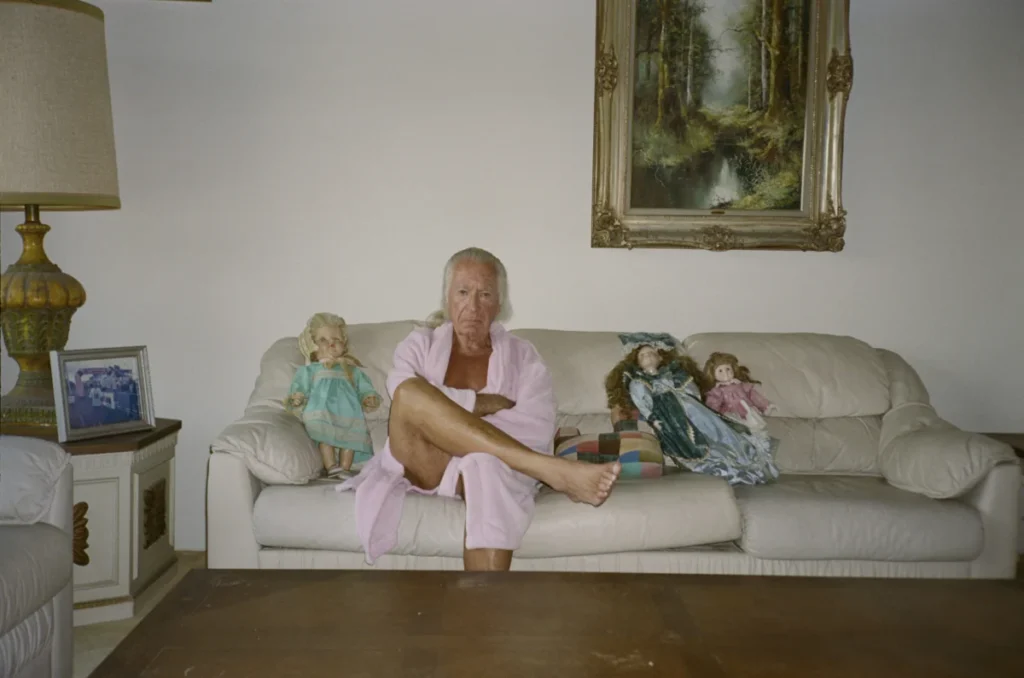

The Hollywood spotlight recently illuminated an unlikely figure from San Diego, 72-year-old Danny Smiechowski, whose long-standing neighborhood disputes, stemming from his distinctive habit of exercising in yellow briefs in his driveway, culminated in a dramatic transformation. Once an ostracized resident, Smiechowski found himself chauffeured in a limousine to a splashy finale event in Hollywood, the unexpected star of the acclaimed HBO/A24 documentary series, Neighbors. This remarkable turn of events not only validated his enduring individuality but also underscored the series’ unique exploration of localized community conflicts and the profound human stories embedded within them.
The Genesis of an Unconventional Celebrity
For years, Smiechowski’s San Diego neighborhood was a battleground of passive aggression and outright disdain. His preference for minimal attire during his daily exercise routine in his driveway was met with insults and social isolation, experiences he vividly describes as "emotional abuse." This deeply personal struggle became the unexpected fodder for a national television series, illustrating the often-unseen tensions simmering beneath the surface of seemingly ordinary suburban life. Smiechowski’s journey from a figure of local derision to a celebrated television personality is a testament to the power of media to reframe narratives and challenge preconceived notions about eccentricity and community.
The moment of his limousine pick-up, observed by his incredulous neighbors, was a poignant full-circle experience. "The neighbors were looking out their window, going, ‘Oh my God, that guy,’" Smiechowski recounted over coffee (or rather, water) in West Hollywood, mimicking their disbelief. "You can’t really believe it could be true, but it’s true." Sitting alongside him, Neighbors creators Harrison Fishman and Dylan Redford shared a laugh, acknowledging the surreal nature of the moment. "Amazing," Fishman remarked, "They must be like, ‘What’s going on?!’" This anecdote perfectly encapsulates the series’ core premise: transforming the mundane, often petty, conflicts of everyday life into compelling television.
"Neighbors": A Deep Dive into Community Microcosms
Neighbors, billed as a late-night documentary series, distinguishes itself through its immersive and often chaotic portrayal of intense disputes across various American communities. The show’s aesthetic and narrative approach recall the distinctive style of its executive producers, Josh Safdie, Ronald Bronstein, and Eli Bush, known for their work on gritty, hyper-realistic films like Marty Supreme. Rather than presenting polished, neatly resolved conflicts, Neighbors opts for a raw, unfiltered lens, intercutting between multiple feuds to paint a broader picture of human friction and coexistence.
The first season comprised six episodes, each delving into different local skirmishes. However, the finale marked a significant departure, dedicating an entire supersized episode exclusively to Smiechowski’s saga. This singular focus amplified the personal stakes and allowed for a deeper character study, tracing Smiechowski’s narrative arc from his initial unhappiness in San Diego, through a transformative stint in a Florida nudist community, and ultimately back to his original home. The finale’s conclusion, that "home is home, for better or worse," serves as a fitting thematic anchor for a series dedicated to the often-brutally funny and perpetually frustrating indignities of living alongside others.
The show’s production style, reminiscent of cinéma vérité but with a heightened sense of urgency and intimacy, pushes the boundaries of reality television. Unlike many "unscripted" shows that rely on manufactured drama or heavily edited narratives, Neighbors appears committed to capturing genuine human interaction and conflict, allowing viewers to witness the raw emotions and irrationalities that often define neighborhood disagreements. This approach, while potentially uncomfortable for some, offers a compelling, unvarnished look at the social fabric of America.

The Journey to Eden and Back: Smiechowski’s "Natural Experiment"
Smiechowski’s involvement with Neighbors began several years prior, when he responded to a Craigslist ad posted by casting director Harleigh Shaw. His motivation was clear: "I just wanted to do it to get the word out," he stated, hoping to shed light on his experiences. After an initial conversation, a prolonged silence followed, stretching for over a year, during which Smiechowski’s frustration grew to the point of blocking the phone numbers of most individuals associated with the production. Fortunately, producer Rachel Walden was spared this digital blockade and eventually reconnected with him when the team was ready to proceed.
The turning point in Smiechowski’s storyline came with a unique proposition. "We had come across a couple disputes in nudist communities… and Harleigh had the idea of, ‘Would Danny be interested in living in a place like this?’" Fishman explained. Redford added, "He had considered moving at various points, so it felt like a natural experiment that Danny was interested in doing and wanted to try." This "experiment" formed the crux of his finale episode, offering both Smiechowski and the audience a stark contrast to his San Diego existence.
The show meticulously documented Smiechowski’s initial experiences in San Diego, capturing locals’ vocal criticisms of his attire. His bewilderment at their judgment was palpable. "I do it to be happy, I do it because I feel good inside — I feel younger," Smiechowski articulated, explaining his preference for minimal clothing. He reflected on the irony: "What’s so ironic about this is that for the people who were abusing me — and are abusing me — this is almost impossible for them to believe." This segment effectively established the conflict that had defined a significant portion of his life.
Upon arriving at Eden, the Florida nudist community, Smiechowski experienced a profound sense of liberation. The cameras followed him as he integrated into a welcoming group, embraced the freedom of the environment, sang karaoke with newfound enthusiasm, and even developed a romantic interest in a much younger woman. This period presented a "naked"—both literally and figuratively—portrayal of Smiechowski, seemingly vulnerable yet unburdened. He, however, did not perceive it as vulnerability. "I just threw caution to the wind — if they say jump, I say how high, and that’s what we did," he asserted, describing his commitment to the documentary process. His dedication was evident in his willingness to repeat actions "literally 20 times until I got it right," attributing this tenacity to his "Iron Man" constitution. He further elaborated on his unique mental fortitude, recounting an anecdote about a hypnotist unable to "crack" him, reinforcing his belief in his exceptional resilience.
The Power of Exposure and the Sweetness of Success
The impact of Neighbors on Smiechowski’s life has been immediate and profound. His newfound celebrity has undeniably shifted the dynamics within his San Diego neighborhood. "The best revenge is success, so that’s the nail in the coffin with [my neighbors] — and now they ignore me," Smiechowski declared. He shared a striking example of this reversal: a French neighbor who had "betrayed" him during his mayoral campaign, calling him a "crook," recently left a message. "’Wow, congratulations. Can I go to LA with you?’ Like, oh my God — what are these people thinking?" This anecdote vividly illustrates how public recognition and perceived success can recalibrate social interactions, even with long-standing adversaries.
Beyond these dramatic individual reactions, Smiechowski reports a tangible improvement in his home situation, estimating it to be "about 90% better" since filming concluded and he returned to San Diego. This suggests that the series, by bringing public scrutiny to his situation, may have inadvertently fostered a more tolerant, or at least less overtly hostile, environment for him.
Despite the potential for renewed public scrutiny and criticism following the show’s airing, Smiechowski remains undeterred. He has embraced his burgeoning public persona, enrolling in drama classes and attending consistently in the lead-up to the episode’s release. He acknowledges the likely negative reactions: "People are going to call me a freak, but they don’t understand… Even my drama teacher said to me, ‘Danny, I’m really sorry for you. You’re going to take a lot of abuse.’" Yet, Smiechowski’s resilience shines through: "I said, ‘George, don’t even worry about it, man. Water off the duck’s back. Just forget about it.’" This unwavering self-acceptance resonated deeply with the show’s creators. Fishman, turning to Smiechowski with a smile, aptly summarized his subject’s essence: "It’s rare to find somebody who is so truly themself. You’re, like, aggressively yourself." This sentiment encapsulates the show’s broader celebration of individuality, even in the face of societal pressure to conform.

Reflecting on Nudist Communities and Broader Societal Norms
The creators of Neighbors gained unexpected insights during their exploration of nudist communities. Fishman and Redford noted a stark contrast between these environments and the often-contentious neighborhoods they typically documented. "Once we got in there, we saw that a lot of these communities were actually functioning at a much higher and more forgiving level than many of the neighborhoods that we had been to throughout the country," Redford observed. He elaborated that residents "really wanted these communities to work. They didn’t want to lose it. They didn’t want the infighting or whatever conflict existed within there to get to a point where they would lose this place that they love so much." Fishman succinctly added, "People were so happy there. It was insane."
These observations challenge conventional perceptions of nudist communities, presenting them not as mere havens for exhibitionism, but as functional social structures built on mutual respect and a shared desire for harmony. This juxtaposition with the often-petty and intractable conflicts depicted elsewhere in the series offers a subtle but powerful commentary on what truly constitutes a "healthy" community, regardless of outward appearance.
Smiechowski, while acknowledging the positive aspects of his experience in Eden, remains pragmatic about the likelihood of widespread societal change in perception. He believes that only "a minority that will… gravitate or become interested" in the nudist lifestyle. "For most people, it’s too socially dangerous. They would be embarrassed. Most people couldn’t do it," he stated, highlighting the deeply ingrained social conditioning that discourages such practices. When asked if he still considers himself part of the nudist community despite living outside it, Smiechowski offered an "existential question" in response: "My behavior, where I live, is somewhat related to that community." This nuanced perspective underscores the lasting influence of his experience and the ongoing evolution of his identity.
The Future of "Neighbors" and its Cultural Impact
Neighbors has been officially renewed for a second season, a testament to its unique appeal and the compelling nature of its premise. While Danny Smiechowski’s return for another round seems unlikely, given his newfound peace on his block, the creators see immense potential for future explorations. "There’s so many subjects and places that we didn’t get to explore in season one for a bunch of different reasons, so we’re just so excited to get back and see what’s out there," Fishman enthusiastically stated. He views the series as an ongoing endeavor to "paint this portrait of America," suggesting that each new story adds a vital layer to a complex national tapestry of community dynamics. "The more that we add to it, the more exciting it gets," he concluded.
The success of Neighbors and its distinctive approach contribute significantly to the evolving landscape of documentary filmmaking and reality television. It stands as an example of how micro-conflicts, often dismissed as trivial, can serve as powerful lenses through which to examine broader societal issues such as privacy, individuality, social acceptance, and the very definition of community. The show’s raw, observational style, coupled with the deeply personal narratives it unearths, invites viewers to confront their own biases and assumptions about their neighbors and the world around them.
Furthermore, Neighbors highlights the ethical considerations inherent in documenting real-life disputes. While offering a platform for individuals like Smiechowski to share their stories and potentially find resolution, it also exposes personal conflicts to a mass audience, raising questions about privacy, consent, and the responsibility of media creators. However, by focusing on genuine, often relatable, human experiences, the series manages to transcend mere voyeurism, offering instead a compelling and thought-provoking commentary on the universal challenges of human coexistence.
The series is now streaming in its entirety on HBO Max, providing audiences with an opportunity to delve into the fascinating and often bewildering world of neighborhood disputes, culminating in the triumphant, if unconventional, tale of Danny Smiechowski. His journey from local pariah to celebrated figure encapsulates the show’s profound ability to uncover extraordinary stories within the seemingly ordinary fabric of American life, proving that sometimes, the most compelling drama unfolds right next door.