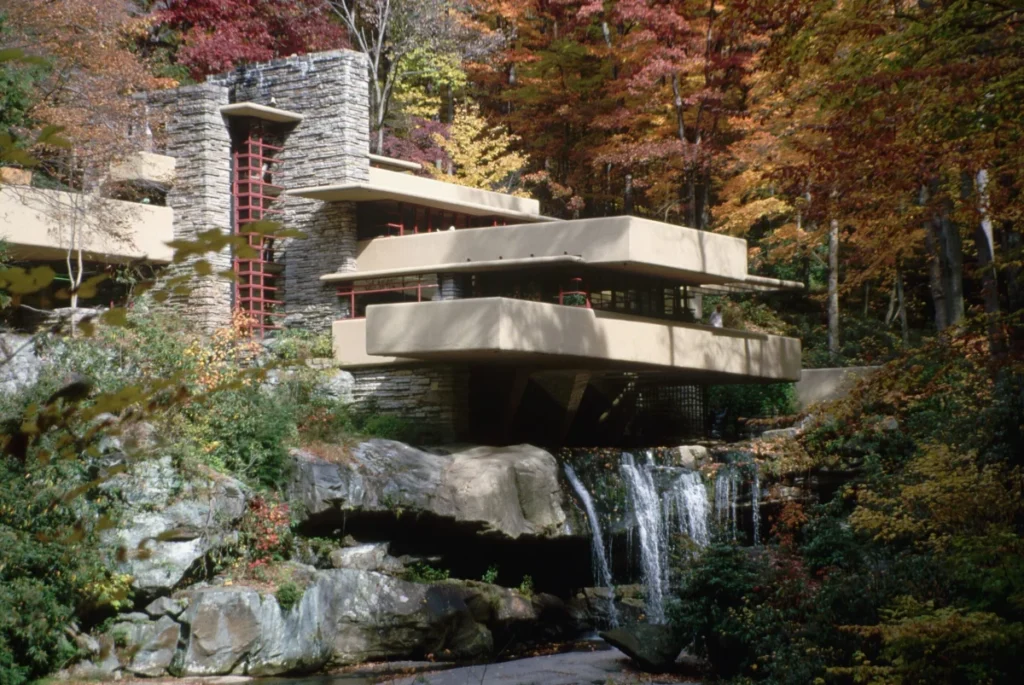

The scaffolding that has for three years shrouded portions of Frank Lloyd Wright’s most celebrated residential achievement, Fallingwater, has finally been dismantled, signaling the conclusion of a comprehensive $7 million restoration effort. This ambitious undertaking, led by the Western Pennsylvania Conservancy (WPC), represents a significant milestone in the ongoing stewardship of the 89-year-old architectural marvel. The project was designed not to alter the home’s iconic aesthetic, but rather to fortify its structural integrity against the very elements that define its beauty. By addressing chronic issues such as water infiltration and material degradation, the conservancy has ensured that the residence—often cited as the most famous private home in the world—remains a viable educational and cultural site for future generations.
Located in Mill Run, Pennsylvania, approximately 70 miles southeast of Pittsburgh, Fallingwater was originally commissioned in 1935 as a weekend retreat for the Kaufmann family. The recent renovation marks one of the most intensive periods of preservation since the home was bequeathed to the Western Pennsylvania Conservancy in 1963. The $7 million investment targeted critical areas of the structure, including a total replacement of the roof systems, the restoration of exterior masonry and woodwork, and the refurbishment of the home’s signature steel-framed doors and windows. With the work now complete, the site has fully reopened to the public, offering a refreshed perspective on Wright’s philosophy of "Organic Architecture."
The Vision of Organic Architecture: Context and Design
To understand the necessity of a $7 million renovation, one must first understand the daring, and at times precarious, nature of Fallingwater’s original design. In the mid-1930s, Frank Lloyd Wright’s career was in a state of perceived decline. However, the commission from Edgar J. Kaufmann Sr., the owner of Pittsburgh’s Kaufmann’s Department Store, provided the architect with an opportunity to reassert his dominance in the field.
Wright’s vision for the site was radical. While the Kaufmanns expected a house with a view of the waterfall on their Bear Run property, Wright insisted that the home be built directly over the falls. His goal was to move the inhabitants beyond mere observation of nature, stating, "I want you to live with the waterfall, not just at it." This was achieved through the use of reinforced concrete "trays" or cantilevers, which were anchored into the natural Pottsville sandstone of the site. These terraces appear to float over the rushing water, creating a seamless integration between the man-made structure and the geological formations beneath it.
The design was famously produced with astonishing speed. According to historical accounts from Wright’s apprentices, the architect had spent months thinking about the site but had not put a single line on paper. When Kaufmann called to say he was driving to Wright’s studio in Taliesin to see the plans, Wright reportedly sat down and drew the complete set of floor plans and elevations in the few hours it took for his client to arrive. Despite this rapid drafting, the technical complexity of the building was immense, utilizing materials and engineering techniques that pushed the boundaries of what was possible in 1936.
The Inherent Challenges of a House Over Water
While Fallingwater is an aesthetic triumph, its location—perched directly over a mountain stream in a dense forest—presents a perpetual battle against the environment. The very features that make the house world-renowned also make it a preservationist’s nightmare. The high humidity levels of the Laurel Highlands, combined with the constant spray from the waterfall and the freeze-thaw cycles of Pennsylvania winters, create a high-moisture environment that is hostile to concrete, steel, and wood.
Jamie Gunther, Fallingwater’s director and vice president of the Western Pennsylvania Conservancy, highlighted these unique difficulties in a recent briefing. She noted that while a standard homeowner might expect to replace a roof every quarter-century, the complexities of Fallingwater’s geometry and its relationship to the stream bed multiply those challenges exponentially. The flat roofs and expansive terraces, while central to the home’s horizontal silhouette, are prone to ponding and leaks. Over the decades, water had begun to penetrate the building’s envelope, threatening the interior finishes and the structural steel embedded within the concrete.
The three-year project, which began in earnest in 2022, was a preventative and corrective response to these environmental pressures. The $7 million budget was allocated toward a meticulous "top-down" approach, ensuring that the building was watertight before interior conservation could be considered. This involved stripping the old roofing materials down to the structural slabs and installing modern, high-performance waterproofing membranes that are invisible to the casual visitor but essential for the building’s longevity.
A Chronology of Stewardship and Structural Intervention
The recent $7 million project is the latest chapter in a long history of intervention. The Kaufmann family themselves realized early on that the house required constant attention. Almost immediately after construction was completed in 1937, the cantilevers began to show signs of "deflection"—a technical term for sagging.
- 1936–1939: Construction of the main house and guest house. Wright and the contractor, Walter Hall, frequently clashed over the amount of steel reinforcement required for the concrete terraces.
- 1955: The Kaufmanns documented that the main living room terrace had tilted downward by approximately four inches. Structural concerns were mounting, though no immediate catastrophic failure was imminent.
- 1963: Edgar Kaufmann Jr. donated Fallingwater and 1,500 acres of surrounding land to the Western Pennsylvania Conservancy, ensuring its preservation as a public site.
- 2001–2002: The most critical structural intervention in the home’s history occurred. Engineers utilized a process called "post-tensioning," where high-strength steel cables were threaded through the cantilevers and tightened to stop the sagging and prevent a potential collapse into Bear Run.
- 2019: Fallingwater was inscribed on the UNESCO World Heritage List as part of "The 20th-Century Architecture of Frank Lloyd Wright," a designation that carries rigorous requirements for maintenance and authenticity.
- 2022–2025: The current $7 million renovation phase focuses on the building’s envelope, including roofing, masonry, and the restoration of the iconic "Cherokee Red" steel window frames and doors.
Technical Details of the Recent Restoration
The scope of the 2022–2025 renovation was both broad and deep. Beyond the roof replacement, significant work was done on the home’s exterior walls. Fallingwater features a unique combination of native stone masonry and smooth, light-ochre colored concrete surfaces. The stone walls, laid in a horizontal pattern to mimic the natural rock strata, required "re-pointing"—the process of removing old, failing mortar and replacing it with a custom-blended mortar that matches the original in color, texture, and breathability.
The steel-framed windows and doors, which provide the "transparent" walls of the house, were another major focus. These elements are vital to Wright’s concept of "breaking the box" and connecting the interior to the outdoors. Over time, the steel frames had suffered from corrosion due to the humid microclimate. Restoration experts carefully removed layers of old paint, treated the metal for rust, and applied a fresh coat of the specific "Cherokee Red" pigment that Wright favored for nearly all his metalwork.
Furthermore, the renovation addressed the home’s wooden elements. Fallingwater features extensive built-in furniture and walnut cabinetry designed by Wright. While the recent project was primarily exterior-focused, ensuring a watertight seal was the primary defense for these priceless interior components. The conservancy also utilized this period to upgrade the estate’s infrastructure, improving drainage systems to better manage the runoff from the hillside behind the house.
Official Responses and the Impact of UNESCO Status
The completion of the project has been met with acclaim from the architectural and preservation communities. Officials from the Western Pennsylvania Conservancy emphasized that the $7 million investment was made possible through a combination of private donations, state grants, and the support of the Kaufmann family’s legacy funds.
The UNESCO World Heritage designation in 2019 added a layer of international accountability to the project. Being part of a World Heritage site means that any restoration work must adhere to the highest international standards of conservation. The goal is to preserve "Outstanding Universal Value," meaning the work must be reversible where possible and must use materials that are chemically and aesthetically compatible with the original structure.
"The successful completion of this phase of work ensures that Fallingwater remains an authentic experience," a spokesperson for the WPC stated. "When visitors stand on the bridge and look at the house, they are seeing exactly what Wright intended, but with the hidden security of modern engineering protecting the structure from the inside out."
Implications for Tourism and Regional Economy
Fallingwater is not only a cultural treasure but also a primary economic driver for the Laurel Highlands region of Pennsylvania. Before the pandemic, the site attracted over 160,000 visitors annually from across the globe. The three-year renovation period required careful scheduling to ensure that the site remained open to tourists, even as scaffolding obscured certain views.
The conclusion of the work is expected to spark a renewed surge in tourism. The Western Pennsylvania Conservancy has announced a full schedule of programming for the 2025 season, including specialized architectural tours, educational residencies, and landscape treks. The economic impact of these visitors extends to local hotels, restaurants, and small businesses in Ohiopyle and the surrounding Fayette County.
Moreover, the project serves as a case study for the preservation of modern architecture. Unlike ancient stone ruins, 20th-century buildings made of reinforced concrete and large glass panes present unique "aging" problems. The lessons learned at Fallingwater regarding concrete conservation and moisture management are frequently shared with other Wright-designed sites, such as the Guggenheim Museum in New York and Taliesin in Wisconsin.
Looking Ahead: The Future of the Masterpiece
With the scaffolding gone, Fallingwater has returned to its pristine state, appearing as a natural outcropping of the Pennsylvania woods. However, the Western Pennsylvania Conservancy remains vigilant. Preservation at Fallingwater is not a finite task but a continuous cycle of monitoring and maintenance.
Future projects are expected to focus on the interior textiles and the conservation of the Kaufmann family’s extensive art collection, which remains in the house. This collection includes works by Diego Rivera and Pablo Picasso, as well as significant pieces of Japanese art, all of which require a stable environment—an environment now secured by the newly replaced roof and restored walls.
Tours of Fallingwater are currently available to the public. The site operates daily, except for Wednesdays, from 8:30 a.m. to 4:30 p.m. through November 30. During the month of December, the house will be open for weekend tours, allowing visitors to experience the winter landscape that so influenced Wright’s choice of materials and colors.
As Fallingwater approaches its centennial in 2035, the successful completion of this $7 million renovation ensures that the "house over the waterfall" will continue to stand as the definitive example of how humanity can build in harmony with the natural world. Wright’s "sleeves" may have shaken the building out in a matter of hours, but it is the meticulous, multi-million-dollar labor of the 21st century that will keep it there.