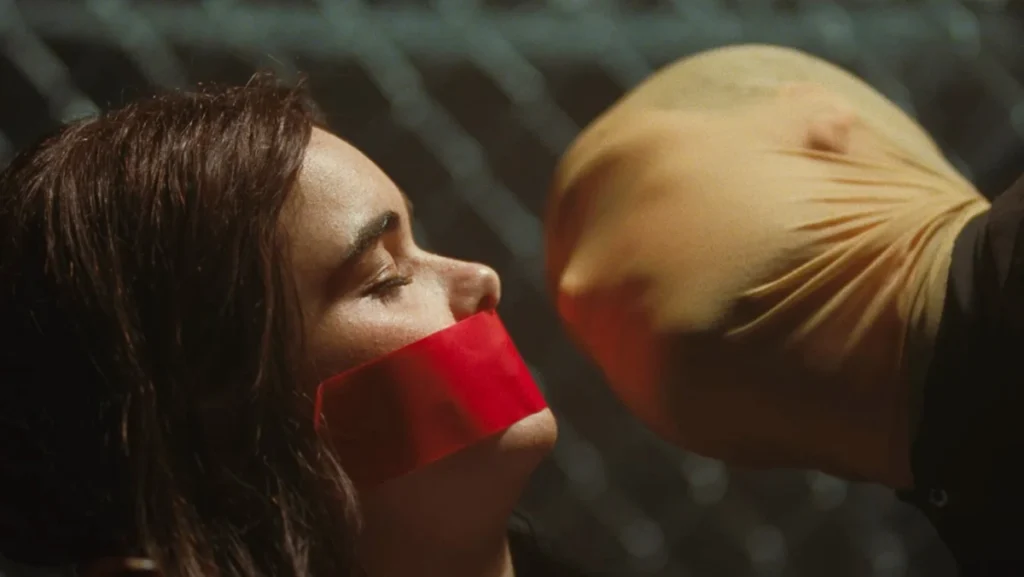

The recent release of the new Faces of Death film, directed by Daniel Goldhaber and co-written with Isa Mazzei, presents a complex case study in modern horror cinema, media commentary, and the enduring appeal of exploitation. Positioned by its creators as a deep dive into societal desensitization to violence, the ethics of consuming graphic imagery, and humanity’s seemingly insatiable hunger for real-life carnage, the film aims to "hold a mirror up to the toxic media ecosystem we live inside of." Yet, this ambitious intellectual framing immediately clashes with the filmmakers’ own description of the project as "an exploitation of an iconic exploitation film," a statement that succinctly captures the inherent tension at the heart of this contemporary reimagining.
Released on Friday, April 10, and starring Barbie Ferreira, Dacre Montgomery, Josie Totah, and Jermaine Fowler, among others, with a runtime of 1 hour and 38 minutes, the film has been rated R. Its central narrative, revolving around a content moderator confronting the grim legacy of its notorious predecessor, attempts to ground its horrific premise in a timely commentary on digital media. However, initial critical reception, encapsulated by the succinct "Not nearly as thoughtful as it thinks it is," suggests a potential disconnect between its lofty intentions and its ultimate execution.
Historical Context: The Original Faces of Death and Mondo Horror
To fully appreciate the new Faces of Death, it is crucial to understand the cultural phenomenon that was the original 1978 film. Conceived by director John Alan Schwartz (credited as "Conan Le Cilaire") and narrated by "Dr. Francis B. Gross," the low-budget production quickly ascended to cult status, largely thanks to the burgeoning home video market of the VHS era. The original Faces of Death was a quintessential example of the "mondo horror" genre, a controversial subgenre that emerged in the early 1960s with films like Gualtiero Jacopetti and Franco Prosperi’s 1962 Italian shockumentary, Mondo Cane. These films purported to showcase authentic, unedited footage of shocking or bizarre real-world events, often focusing on exotic rituals, cultural peculiarities, and, most famously, graphic violence and death.
The 1978 Faces of Death pushed these boundaries further, presenting itself as a documentary cataloging various forms of death, from animal slaughter and accidental fatalities to executions and autopsies. While much of the footage was indeed genuine, including scenes of animal cruelty (which generated significant controversy and legal challenges in some regions) and actual archival material, a substantial portion was cleverly staged or faked with varying degrees of realism. This blend of authentic and simulated gore was key to its appeal and its notoriety. The film’s mystique was further amplified by urban legends and playground rumors about the authenticity of its most disturbing scenes.
Despite its often crude production values, the original Faces of Death proved immensely profitable, capitalizing on morbid curiosity and a hunger for taboo content. It spawned numerous direct-to-video sequels and spin-offs throughout the 1980s and 1990s, solidifying its place as a veritable cottage industry built on the allure of forbidden imagery. Its impact extended beyond direct sequels, influencing the development of the "found footage" genre and setting a precedent for media that blurred the lines between reality and fiction to elicit extreme reactions. The film’s legacy lies in its pioneering role in testing the limits of media consumption and public taste, becoming a touchstone for discussions about censorship, ethical filmmaking, and the psychology of voyeurism.
The Contemporary Reimagining: Intentions and Narrative
The new Faces of Death arrives at a time when the "toxic media ecosystem" its creators claim to critique is more pervasive than ever. Director Daniel Goldhaber, known for the critically acclaimed techno-horror film Cam (2018) and the eco-thriller How to Blow Up a Pipeline (2022), brings a distinct sensibility to this reboot, or "exploration" as he and co-writer Isa Mazzei prefer. Their stated aim is to delve into the modern implications of the original film’s themes, particularly in an era saturated with user-generated content, viral violence, and algorithmic amplification.
The narrative centers on Margo (Barbie Ferreira), a content moderator for a fictional YouTube-like video-sharing platform named Kino. Margo’s daily life is a stark illustration of the digital age’s moral quandaries. Tasked with sifting through a constant stream of objectionable uploads, she must make instant, often agonizing decisions about what content to permit or remove. Her personal history—marked by a tragic past involving internet notoriety—adds a layer of psychological complexity to her professional burden, highlighting the personal toll of engaging with digital depravity.
Margo’s internal struggle is contrasted with the more cynical, commercially driven approach of her supervisor (Jermaine Fowler), who embodies the platform’s prioritization of engagement over ethics. His mantra, "Give the people what they want!", directly reflects the pressures faced by real-world social media companies to retain users and maximize views, often at the expense of content quality or moral responsibility. This dynamic sets the stage for the film’s exploration of the "attention economy," where shock value and controversy frequently translate into profitability.
Plot Progression and Thematic Unveiling
The core conflict of the film ignites when Margo begins to notice a disturbing pattern: several newly uploaded videos on Kino bear an uncanny resemblance to scenes from the original 1978 Faces of Death. The eerie familiarity, even highlighted by a user comment ("This reminds me of Faces of Death"), prompts her to investigate. She unearths a VHS tape of the original film from her office library, embarking on a gruesome comparative analysis that allows the new film to integrate clips from its notorious predecessor, creating a meta-textual dialogue between the past and present iterations of exploitation.
Margo’s investigation leads her to a chilling realization: these aren’t mere homages or staged recreations; they are actual, contemporary murders, meticulously crafted to mimic the morbid vignettes of the 1978 film. The architect of this gruesome artifice is Arthur (Dacre Montgomery), a serial killer who uses the internet and the legacy of Faces of Death as both his canvas and his distribution channel. Montgomery portrays Arthur with a chilling blend of calculated menace and theatricality, often appearing in red contact lenses and a mask, embodying a demonic figure driven by a warped understanding of media and public demand.
Arthur is not merely a killer; he is a product and a commentator on the "attention economy." When he eventually confronts Margo, he revels in the notoriety, inquiring, "Are you a fan of my work?" His dialogue serves as the film’s most direct exposition of its thematic concerns. "It’s the attention economy," he boasts, "And baby, business is booming!" He further articulates his perverse methodology by drawing parallels to the film industry itself, stating, "The algorithm loves remakes… people love remakes. If it’s a remake, you can get away with murder." This meta-commentary, reminiscent of the Scream franchise’s self-awareness, positions Arthur as a villain who understands and exploits the mechanics of contemporary media consumption, turning a classic exploitation film into a blueprint for real-world horror in the digital age.
Cast and Production Insights
The cast of Faces of Death brings a mix of established and rising talent to the project. Barbie Ferreira, widely recognized for her role in HBO’s Euphoria, delivers a compelling performance as Margo, anchoring the film with her portrayal of a character grappling with both external threats and internal trauma. Her ability to convey vulnerability alongside burgeoning resilience is critical to making Margo a relatable and engaging protagonist. Dacre Montgomery, known for his menacing turn in Stranger Things, fully embraces the role of Arthur, transforming into a chilling antagonist whose intellectual justifications for his crimes are as disturbing as his actions.
The film also features supporting performances from Jermaine Fowler (Coming 2 America), who provides a cynical counterpoint as Margo’s supervisor, and Josie Totah, Aaron Holliday, and Kurt Yue. Notably, the artist Charlie XCX also appears in a small role, adding a touch of unexpected star power that might intrigue a broader audience beyond traditional horror fans. The production team, led by director Daniel Goldhaber, endeavors to weave together the original film’s aesthetic with a modern narrative, leveraging both archival footage and newly shot, ultra-violent scenes to achieve its desired effect. The cinematography aims to evoke the grainy, found-footage feel when showcasing Arthur’s videos, contrasting it with a more polished look for Margo’s real-world experiences, further blurring the lines between what is "real" and what is "media."
Critical Reception and Thematic Efficacy
Despite its intriguing premise and the filmmakers’ stated intentions to offer a profound critique of media consumption, the new Faces of Death has garnered a nuanced reception. The central criticism suggests that the film, for all its intellectual posturing, ultimately devolves into a relatively conventional horror-thriller. While it effectively builds tension and delivers on gruesome imagery, its aspirations to be a thoughtful commentary on desensitization and media ethics often give way to a standard cat-and-mouse narrative between a plucky heroine and a psycho villain.
The film’s strength lies in its ability to generate suspense and feature strong performances from Ferreira and Montgomery. However, its self-proclaimed status as an "exploration" or a mirror held up to society feels diluted by its reliance on familiar horror tropes. The meta-commentary, while present in Arthur’s monologues, sometimes feels didactic rather than organically integrated into the narrative. This leads to the sentiment that the film is "Not nearly as thoughtful as it thinks it is," struggling to reconcile its high-minded thematic ambitions with its identity as a horror film designed to exploit its iconic predecessor.
IFC Films’ decision to give Faces of Death its widest release ever underscores the commercial confidence in the project, particularly its ability to tap into the enduring public fascination with morbid content. This strategy implicitly validates Arthur’s cynical observation about the "attention economy" and the market for extreme imagery. It suggests that even in an era of heightened awareness about online violence and content moderation, the allure of the forbidden, especially under a recognizable and controversial title, remains a potent draw for audiences. The commercial success of the original Faces of Death decades ago, despite its dubious authenticity and ethical concerns, serves as a powerful reminder that, as the original film proved, "you can’t go broke underestimating the public’s taste."
Broader Implications: Media, Morality, and the Attention Economy
The new Faces of Death, irrespective of its critical reception, opens a crucial dialogue about several contemporary societal issues. At its core, the film addresses the escalating challenges of content moderation in the digital age. Margo’s daily plight reflects the immense burden placed on human moderators, who must navigate a vast, often horrifying, landscape of user-generated content, making split-second decisions with significant psychological and ethical implications. This aspect highlights the ongoing debate about freedom of speech versus platform responsibility, and the mental health toll on those tasked with policing online communities.
Furthermore, the film directly confronts the toxic media ecosystem and the desensitization to violence that many argue is a hallmark of modern society. With the proliferation of graphic content readily available online—from real-world conflict footage to highly stylized fictional violence—the lines between entertainment and reality have become increasingly blurred. The film prompts viewers to question their own complicity in this ecosystem: Does watching violent imagery, even under the guise of critique or entertainment, contribute to a broader desensitization? Does the act of consuming such content fuel the "ravenous appetite for real-life carnage" that the filmmakers allude to?
Arthur’s character serves as a chilling personification of the attention economy, a concept describing how content creators and platforms compete for user engagement, often by employing sensational or extreme material. His justification for murder as a form of content creation that "the algorithm loves remakes" is a stark, albeit exaggerated, critique of how metrics like views, likes, and shares can incentivize increasingly provocative and ethically dubious content. This raises questions about the moral responsibility of platforms, content creators, and consumers in shaping the digital landscape.
Finally, the film, by revisiting an iconic exploitation property, also speaks to the cyclical nature of exploitation and the enduring appeal of taboo. The original Faces of Death pushed boundaries in its time, and its remake attempts to do the same for a new generation, adapting the concept to contemporary anxieties about digital media. This cycle suggests that as societal norms and technological capabilities evolve, so too do the forms and justifications for exploiting human curiosity about the darkest aspects of existence.
In conclusion, the new Faces of Death stands as a provocative, if imperfect, entry into the horror genre. While it may not fully deliver on its promises of profound social commentary, its very existence and the discourse it generates serve as a mirror to our current media landscape. It underscores the ongoing fascination with death and violence, the complexities of content moderation in the digital age, and the insidious pull of the attention economy. The film, much like its predecessor, ultimately challenges audiences to consider their own relationship with the macabre and the ethical implications of what we choose to watch.