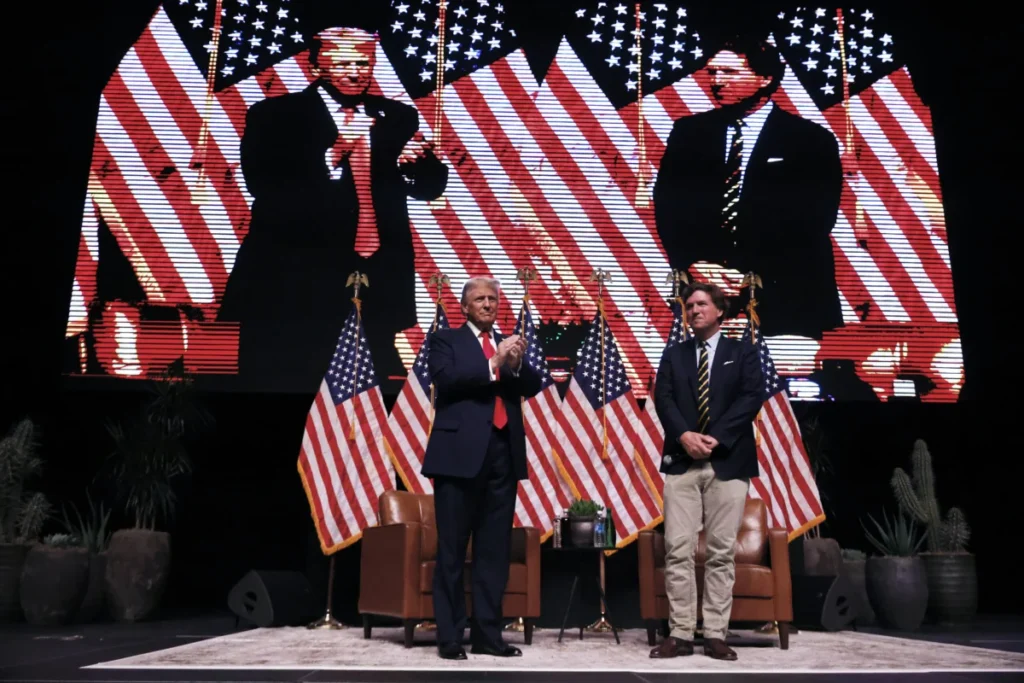

A public and increasingly acrimonious war of words has erupted between former President Donald Trump and conservative media personality Tucker Carlson, marking a significant fracturing within the broader MAGA movement. The dispute escalated after Carlson, a former Fox News host and now a prominent independent voice in conservative media, sharply criticized Trump’s Easter morning social media post threatening Iran and went so far as to imply the former president might be pushing the world towards nuclear conflict, even suggesting he could embody the Antichrist. Trump, in turn, lashed out at Carlson, labeling him a "fool" and a "low-IQ person" during a conversation with the New York Post.
The Provocation: Trump’s Easter Morning Threats
The catalyst for this high-profile spat was a series of incendiary messages posted by Donald Trump on his Truth Social platform on Easter Sunday. In these posts, Trump issued a profanity-laced ultimatum to Iran, demanding the reopening of the Strait of Hormuz. The Strait of Hormuz is a strategically vital waterway connecting the Persian Gulf with the Arabian Sea and the Indian Ocean, through which approximately 20 percent of the world’s oil supply, and a significant portion of its liquefied natural gas, passes daily. Its closure or disruption would have profound global economic consequences.
Trump’s message was uncharacteristically aggressive, even for his often-provocative style. He threatened severe military action against Iran’s energy infrastructure if the strait remained closed. "A whole civilization will die tonight, never to be brought back again. I don’t want that to happen, but it probably will," Trump wrote, adding, "However, now that we have complete and total regime change, where different, smarter, and less radicalized minds prevail, maybe something revolutionary can happen. Who knows?" He concluded with a chilling warning: "We will find out tonight — one of the most important moments in the long and complex history of the world. Forty-seven years of extortion, corruption, and death will finally end. God bless the great people of Iran! Open the f—ing strait, you crazy bastards, or you’ll be living in hell — just watch! Praise be to Allah." The use of such language, particularly on a major Christian holiday, immediately drew widespread attention and criticism.
Carlson’s Scathing Rebuttal and Eschatological Implications
Tucker Carlson, leveraging his considerable platform, which boasts over 21 million followers across X (formerly Twitter) and YouTube as of late 2025, dedicated a significant portion of his Monday video podcast to dissecting and condemning Trump’s Easter pronouncements. Carlson described Trump’s post as "vile on every level," attacking both its substance and its timing. He specifically criticized the former president for employing vulgar language and threatening mass violence on a day dedicated to Christian reflection and the celebration of Jesus Christ’s resurrection.
"How dare you speak that way on Easter morning to the country?" Carlson demanded, "Who do you think you are? You’re tweeting out that word on Easter morning." His critique extended beyond mere decorum, questioning the very scope of presidential authority implied in Trump’s threats of such catastrophic actions. Carlson then delved into a more speculative and religiously charged argument, invoking Christian eschatology. He suggested that Trump’s actions and rhetoric align with characteristics attributed to the Antichrist – a deceptive political figure in biblical prophecy believed to usher in global upheaval and lead humanity astray before the Second Coming. This highly unusual and provocative accusation marked a significant escalation of Carlson’s criticism, moving beyond policy disagreements into deeply personal and theological territory.
Furthermore, Carlson urged White House staff and other government officials to consider resigning rather than complying with orders they might deem unlawful or dangerously reckless. "Those people who are in direct contact with the president need to say, ‘No, I’ll resign. I’ll do whatever I can legally to stop this, because this is insane. If you give the order, I’m not carrying it out. Figure out the codes on the football yourself,’" he stated, referencing the "nuclear football" carried by presidential aides.
Trump’s Swift and Caustic Counterattack
Donald Trump did not hesitate to respond to Carlson’s critique. In a recent call with the New York Post, Trump dismissed Carlson’s intelligence and influence. "Tucker’s a low-IQ person who has absolutely no idea what’s going on," the former president asserted. He claimed Carlson frequently attempts to contact him, but he no longer takes his calls. "He calls me all the time; I don’t respond to his calls. I don’t deal with him. I like dealing with smart people, not fools," Trump added, effectively severing, at least publicly, any remaining ties of cordiality. This exchange underscores Trump’s characteristic response to criticism, often involving personal attacks and questioning of intelligence or loyalty.
A Volatile Relationship: A History of Tensions and Reconciliations
The current public feud is not an isolated incident but rather the latest chapter in a complex and often turbulent relationship between Donald Trump and Tucker Carlson. Their dynamic has been characterized by periods of alignment and sharp disagreement, reflecting the often-shifting allegiances within conservative media and politics.
Evidence of Carlson’s private disdain for Trump emerged during the Dominion Voting Systems defamation lawsuit against Fox News. Filings from the lawsuit revealed private text messages from 2021 in which Carlson confessed to "passionately" hating Trump and described him as a "demonic force." These texts provided a stark contrast to his on-air persona, which often appeared supportive of the former president, and offered a glimpse into underlying tensions that predated their current public rift.
Despite these private sentiments, the two appeared to reconcile in 2023 following Carlson’s abrupt ouster from Fox News. Trump publicly defended Carlson after his departure, a move widely seen as an endorsement. Later that year, Trump chose to sit for an interview on Carlson’s independent web show instead of participating in a primary debate hosted by Fox News, a decision that further cemented Carlson’s standing as a significant figure in the MAGA media ecosystem and suggested a renewed alliance. This interview was a major coup for Carlson, demonstrating his continued relevance and Trump’s willingness to bypass traditional media outlets.
However, in recent months, Carlson has increasingly positioned himself as a contrarian voice within the MAGA sphere. While still broadly conservative, he has at times diverged from Trump’s specific rhetoric or policy positions, aligning himself more closely with other figures like Candace Owens and Megyn Kelly, who represent different, sometimes more populist or isolationist, strains of conservative thought. This evolution suggests Carlson is cultivating an identity independent of direct fealty to Trump, potentially aiming to be a kingmaker or a significant ideological force in his own right.
The Broader Context: US-Iran Relations and Geopolitical Stakes
Trump’s Easter threats against Iran must be understood within the broader context of fraught US-Iran relations. For decades, the two nations have been locked in a complex and often adversarial relationship, marked by periods of proxy conflict, economic sanctions, and heightened tensions. The 2015 Iran nuclear deal (Joint Comprehensive Plan of Action – JCPOA), from which Trump withdrew the US in 2018, was an attempt to de-escalate nuclear proliferation concerns, but its collapse led to renewed sanctions and a return to a more confrontational stance.
During his presidency, Trump often adopted a hawkish stance towards Iran, implementing a "maximum pressure" campaign designed to cripple its economy and force concessions. This included escalating sanctions and, at times, bellicose rhetoric. The Strait of Hormuz, a critical chokepoint, has been a recurring flashpoint, with Iran periodically threatening its closure in response to perceived aggressions or sanctions. Any military action targeting Iran’s energy infrastructure, as threatened by Trump, would undoubtedly trigger a severe response, potentially igniting a regional conflict with global implications for oil markets and international security. The casual nature of Trump’s threat, particularly on a religious holiday, raised concerns among foreign policy analysts about the stability and predictability of US foreign policy under such rhetoric.
Religious Rhetoric and Political Discourse: The Antichrist Accusation
Carlson’s invocation of the Antichrist in his critique of Trump is highly significant. In Christian eschatology, the Antichrist is a figure who opposes Christ and deceives humanity, leading many astray through charismatic leadership and false promises before the end times. This accusation, coming from a prominent conservative commentator, is deeply provocative and appeals to a segment of the Christian conservative base that views political events through a biblical lens.
Such rhetoric injects a new, more extreme dimension into political debate. It moves beyond policy disagreements or even character critiques to question the very spiritual nature of a political leader. While many might dismiss it as hyperbole, for some religious conservatives, such accusations can resonate deeply, potentially eroding support or sowing doubt about a figure previously seen as a champion of Christian values. It also highlights the increasing intermingling of religious apocalyptic narratives with contemporary political commentary, a trend that can further polarize public discourse.
Dynamics of the MAGA Sphere and Conservative Media
The clash between Trump and Carlson also offers insight into the evolving landscape of conservative media and the MAGA movement. Carlson’s independent platform has given him a unique position, allowing him to challenge figures who were once considered untouchable within conservative circles. His massive online following demonstrates the power of direct-to-audience communication, bypassing traditional gatekeepers and even established conservative outlets.
This dynamic also brings into focus other conservative media personalities. Megyn Kelly, for instance, a figure with her own complex history with Trump, weighed in on the broader political landscape this week. Despite her past feuds with Trump, Kelly stated that her commitment to the Republican Party would likely override any concerns about Trump’s actions. "I mean, honestly, Trump could drop a nuke and I’d still vote Republican over those people," Kelly quipped on her show, referring to Democrats. Her statement, while perhaps hyperbolic, underscores the intense partisan loyalty that often transcends specific policy or even moral objections for some voters, and highlights the "lesser of two evils" calculus prevalent in today’s polarized political environment. It also implicitly contrasts with Carlson’s more direct moral and theological challenge to Trump.
Implications and Future Outlook
The public feud between Donald Trump and Tucker Carlson carries several significant implications. For Trump, it represents a challenge from within his own ideological ecosystem, potentially alienating some segments of his base who are loyal to Carlson. While Trump’s core support remains robust, sustained criticism from a figure like Carlson could chip away at his broader appeal, particularly among those who prioritize a certain brand of conservative media commentary.
For Carlson, this confrontation solidifies his image as an independent voice, willing to criticize even the most powerful figures in the conservative movement. It reinforces his brand as a fearless commentator, potentially expanding his audience beyond strict MAGA loyalists to those who are disillusioned with mainstream conservative politics or looking for alternative perspectives.
The broader implication for conservative media is a further diversification of voices and a potential fragmentation of influence. As figures like Carlson build independent platforms, the monolithic nature of traditional conservative media is increasingly challenged, leading to a more complex and sometimes contradictory internal dialogue.
Ultimately, this escalating war of words highlights the volatile and unpredictable nature of modern political discourse, especially within the right-wing ecosystem. It underscores the power of social media for direct communication, the growing influence of independent media figures, and the increasing tendency for political debates to intertwine with religious and moralistic framing. As the 2026 political cycle progresses, the ongoing dynamic between these two powerful figures will undoubtedly continue to shape the narrative and direction of the conservative movement.