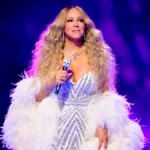

Dalia Mubarak didn’t arrive at the Billboard Arabia March cover shoot as just another cover star. She arrived as a woman carrying her entire life with her. With her two daughters, Lily and Jazz, by her side, the set felt less like a production and more like a natural extension of her reality, where motherhood, work, and creativity coexist. This powerful juxtaposition of her personal and professional life underscores her evolving role as one of Saudi Arabia’s most distinctive voices, at a pivotal moment in both her career and the broader cultural landscape of the Arab world.
A Multifaceted Presence on Set
The atmosphere on set was described as one of immediate familiarity, with Mubarak exuding an effortless, unpretentious demeanor. Far from performing for the cameras, her presence conveyed a deliberate shaping of her life on her own terms, a conviction that resonated through her every action. Moving between takes, she seamlessly transitioned between her roles as a mother attending to her daughters and an artist focused on the creative process. Her warmth and generosity were palpable, offering smiles even amidst the bustling environment of a professional photoshoot. This ability to embody multiple roles simultaneously — mother, woman, and artist — provided the inspiration for the cover story, moving beyond a singular narrative to embrace the complexity of her identity.
A Resonant Cover Choice: International Women’s Day and Mother’s Day
The choice of Dalia Mubarak for the March cover holds particular significance, falling within a month that observes both International Women’s Day and Mother’s Day. This timing amplifies the resonance of her presence, highlighting the intersection of female empowerment and the profound experience of motherhood. As Mubarak navigates a critical juncture in her career, with a new album on the horizon and a highly anticipated role as a coach on The Voice Kids, her journey exemplifies a woman finding profound synchronicity with herself. This period marks a significant evolution, showcasing her growth and renewed artistic vigor.
A Career Built on Purpose and Experimentation
Since her emergence in 2014, Dalia Mubarak has cultivated a career defined by a quiet, yet resolute, sense of purpose. Her artistic approach is characterized by a fluid experimentation with production and visuals, treating them not as mere embellishments but as integral extensions of her sonic identity. She moves effortlessly between different Arabic dialects, a testament to her commitment to reaching a diverse audience and her deep understanding of the nuances within the region’s linguistic tapestry.
Her initial foray into music was deeply influenced by her mother, whose voice she describes with profound admiration. This early exposure laid the foundation for her own musical journey, from tentative auditions to eventually taking on a mentorship role. Her true breakthrough arrived in her early twenties, quickly establishing her as a force pushing the boundaries of Saudi music. Whether through her bold lyrical choices or her skillful reinterpretation of Gulf poetry, Mubarak has consistently infused traditional elements with a contemporary sonic sensibility, championing feminine expression within a modern context.

Expanding Musical Horizons: A Resistance to Stagnation
Mubarak’s discography showcases a continuous expansion of her musical boundaries, drawing inspiration from a diverse array of rhythms and influences. Each release represents a deliberate challenge across voice, language, and performance, defying categorization. Tracks like the contemporary pop anthem "Mara’a Million" (One in a Million Woman) stand in contrast to the traditional Gulf spirit of "Yareitni Rajal" (I Wish I Were a Man). More recently, her venture into the Iraqi dialect with "Arja’ La’en" (Come Back, Because…) demonstrates her willingness to explore new sonic territories. This deliberate avoidance of settling into a single sound is rooted in a lifelong aversion to boredom, a sentiment she has actively combated since childhood and shows no signs of succumbing to.
Early Milestones and Global Recognition
Dalia Mubarak’s career trajectory has been marked by a series of significant milestones achieved at an impressively early age. She became one of the youngest Saudi artists to join the esteemed panel of The Voice Kids as a coach, a testament to her rising prominence. Furthermore, her signing with Warner Music garnered early attention in global Billboard headlines, representing one of the pioneering moves of its kind for a Saudi artist at such a prominent international level. This achievement underscores her role as a cultural ambassador, bridging Saudi talent with the global music industry.
When confronted with these accomplishments, Mubarak’s reaction is one of genuine surprise, as if hearing them for the first time. Off-camera, she reflected, not with boastfulness, but with a touch of introspection, questioning, "I never really reflected on that before… should I have? Maybe." This humility and self-awareness are central to her character, preventing her from becoming detached from the journey itself.
Honesty as an Anchor: The Inseparable Nature of Artist and Work
The same candidness that marked her reflection on her achievements permeated her interview. Mubarak possesses little patience for overly polished or rehearsed conversations. When discussions veered into predictable territory, she instinctively steered them back to more authentic, human experiences. Honesty serves as the unwavering anchor in her discourse. With Dalia, the conversation extends far beyond the music; her personality is intrinsically interwoven with her creative output. This raises an intriguing lens through which to understand her: viewing Dalia through the evocative titles of her songs.
From "Qimmat Tumoohi" (Top of My Ambition) and "Ya Hasidi" (Those Who Envy Me) to "Enta Koni" (You’re My Universe) and "Tamanni ‘Alaik" (Let Me Check in on You), these titles read like fragments of a deeply personal narrative. Each offers a window into a distinct facet of her identity: ambition, defiance, vulnerability, anger, heartbreak, and an enduring drive to reclaim agency over her life. These lyrical landscapes offer profound insights into the emotional core of her artistry.
Navigating Life’s Chapters: Resilience and Redirection
As the conversation deepened, the multifaceted layers of Mubarak’s life became increasingly apparent. The radiant and spontaneous artist also carries the weight of challenging chapters: two marriages, personal disappointments, industry clashes, and moments where stepping away from the spotlight seemed like the most viable option. Yet, juxtaposed against these adversies are significant professional triumphs.

Her current role on The Voice Kids is described as a "divine sign" to persevere, particularly at a time when she was contemplating a complete departure from music. There lies a poignant irony: Dalia, who speaks with profound intensity about motherhood, openly admitting the overwhelming love, emotional exhaustion, and constant worry it entails, found her path back to her artistic self through the very experience of nurturing young talent.
A Renewed Spark: The Transformative Power of Mentorship
Mubarak recounted a particularly impactful moment on the set of The Voice Kids with one of the young contestants. This brief encounter served as a powerful grounding experience, perhaps even a return to her earliest artistic beginnings when the dream was simpler and less burdened by external pressures. With a noticeable tremor in her voice, she shared, "I had lost my passion. The energy I got from the kids reminded me of my dream, why I’m here, why I’m sitting in that chair." She elaborated, "When I sat on The Voice panel and saw the kids, it felt like rescue. I was taking energy from them, and I told myself, ‘Dalia, you’re here because one day, you were there.’" This profound realization reignited her artistic fire, dispelling any thoughts of retirement.
A Bold New Phase: Embracing Diversity and Liberation
Now, Mubarak steps into a new phase of her career, arguably her most energized yet. Her upcoming album promises an even greater spectrum of dialects and musical explorations, with the inclusion of Iraqi alongside her mastery of Egyptian, further broadening her connection with a wider Arab audience. This artistic evolution prompts the question: is this the most liberated version of Dalia Mubarak we have witnessed?
While observers may perceive an artist more daring than ever, Mubarak herself resists being confined to any single identity. She is more than just an artist, more than just a mother, and transcends the conventional narrative of an "inspirational story." What ultimately lingers after engaging with her is something far rarer: a woman who has resolutely reclaimed the center of her own life. She has ceased striving to conform to external expectations and has embraced the power of simply being herself. It is this authentic self-possession that makes her presence on the Billboard Arabia cover feel so profoundly fitting, a true reflection of her journey and her impact.