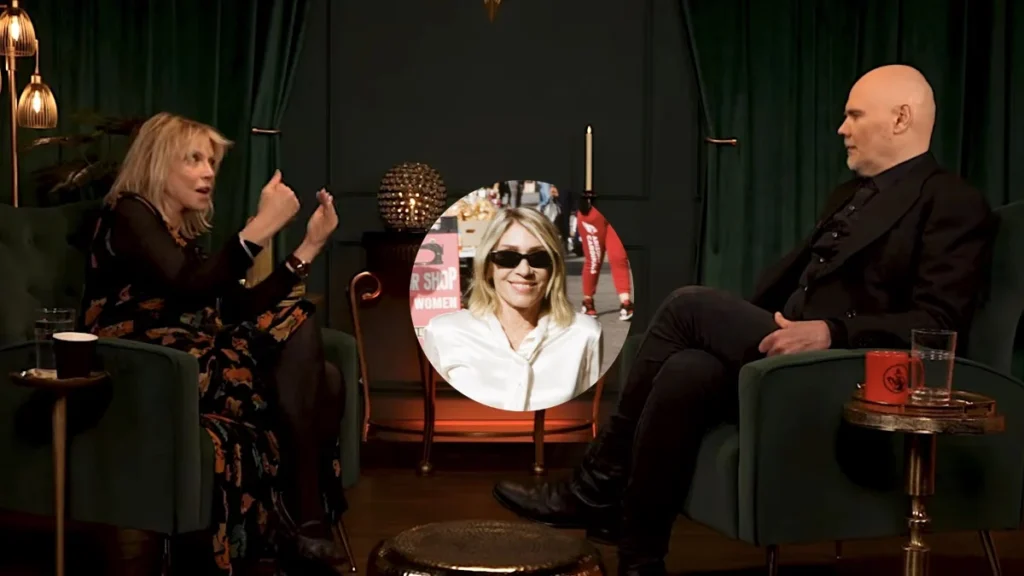

In a candid and revealing conversation on Billy Corgan’s podcast, The Magnificent Others, rock icons Courtney Love and Billy Corgan revisited the tumultuous landscape of 1990s alternative music, offering a provocative reinterpretation of a seminal Nirvana lyric and leveling sharp criticisms against Sonic Youth bassist Kim Gordon. The discussion between the two long-time "frenemies turned friends again" unfolded with an unfiltered honesty, peeling back layers of personal and professional animosity that have simmered for decades within the alternative rock community. The most startling revelation came from Love, who asserted that a key lyric from Nirvana’s iconic 1993 track “Heart-Shaped Box”—“Hey, wait, I got a new complaint / Forever in debt to your priceless advice”—was directed not at her, as many have long believed, but at Kim Gordon, whom both Love and Corgan described as a "horrible" "indie gatekeeper" of the era.
A Deep Dive into ’90s Animosity on The Magnificent Others
The podcast segment, featuring Love as Corgan’s guest, quickly veered into a discussion about "indie gatekeepers," a term frequently used to describe influential figures within independent music scenes who were perceived to control access, define authenticity, and dictate taste. It was in this context that Kim Gordon and her ex-husband, Sonic Youth frontman Thurston Moore, became central to the conversation. Corgan initiated the critique, stating, "I barely know Thurston, but he was never a gatekeeper. But his partner was the worst." Love unequivocally echoed this sentiment, adding, "She was the worst, and she kind of still is." Corgan then affirmed, "Oh, she’s still rockin’ the gatekeeping."
This exchange set the tone for a broader condemnation of Gordon’s perceived conduct and influence during the height of alternative rock’s mainstream explosion. Love recalled a specific instance of feeling marginalized by Gordon, referencing a festival experience in Holland with Corgan. "She was really horrible in the ’90s. I remember being in Holland, hanging out with you [Corgan], and they were so mean," Love recounted. Corgan corroborated the sentiment, sharing his own negative encounter: "Yes, I came into their dressing room because we were all playing this festival — Kurt [Cobain] was playing, Nine Inch Nails was playing, [The Pixies’] Black Francis was playing, Urge Overkill was there… I was a fan [of Sonic Youth], and I came in to pay my respects, and she treated me so rudely by her, and that was the beginning of the horrible relationship." While the specific festival was not named, the lineup of artists mentioned—Nirvana, Nine Inch Nails, Pixies, Urge Overkill, and Smashing Pumpkins—strongly suggests a major European rock festival of the early-to-mid 1990s, such as Pinkpop or Roskilde, which were known for their eclectic, influential lineups. These anecdotes painted a picture of a strained and competitive atmosphere among some of the era’s most prominent artists, challenging the often-romanticized notion of a unified "alternative nation."
A War of Words: Kim Gordon’s Memoir and Reciprocal Criticism
The friction between these figures is not new, nor is it confined to the recent podcast discussion. Both Love and Corgan highlighted that Kim Gordon’s 2015 memoir, Girl in a Band, contained disparaging remarks about them, as well as about contemporary artist Lana Del Rey. Gordon’s book offered her unvarnished perspectives on various figures in the music industry, and her comments regarding Love and Corgan were particularly pointed.
In Girl in a Band, Gordon wrote, "I have a low tolerance for manipulative, egomaniacal behavior, and usually have to remind myself that the person might be mentally ill… Courtney asked us for advice about her ‘secret affair’ with Billy Corgan. I thought, Ewwww, at even the mention of Billy Corgan, whom nobody liked because he was such a crybaby, and Smashing Pumpkins took themselves way too seriously and were in no way punk rock." These excerpts from Gordon’s memoir underscore a deep-seated disdain, framing Corgan as emotionally immature and Smashing Pumpkins as antithetical to the punk ethos, while painting Love in a psychologically unfavorable light. Gordon’s criticisms touched upon the often-contentious debates within the ’90s scene regarding artistic authenticity, commercial success, and the subjective definition of "punk rock." The memoir itself was a significant cultural event upon its release, offering a rare, first-person account from one of alternative rock’s most revered female figures, known for her stoic demeanor and artistic integrity. Its candidness about personal relationships and professional rivalries resonated with many readers, but also reignited old disputes, as is evident from Love and Corgan’s reactions.
Revisiting Nirvana’s "Heart-Shaped Box": A New Interpretation
The most significant revelation from Love’s appearance on Corgan’s podcast concerns the re-contextualization of a foundational Nirvana lyric. Love struggled momentarily to recall the precise lines from "Heart-Shaped Box" before definitively stating, "‘Hey, wait, I got a new complaint / Forever in debt to your priceless advice’ — that’s about Kim. That’s literally about Kim. He was so mad at her." This assertion challenges decades of interpretation, as the song, particularly these lines, has widely been understood as a direct address from Kurt Cobain to Courtney Love, reflecting the intensity and complexity of their relationship. The song’s themes of dependency, confinement, and emotional entanglement have long been seen through the lens of their volatile romance.
Love elaborated on her reasoning, suggesting Cobain’s resentment stemmed from Gordon’s perceived influence and criticism. "Kurt’s whole thing was… he hid his light under a bushel for Bleach, because, one, Seattle, which he wasn’t from, two, Kim Gordon." Love implied that Cobain felt constrained or judged by Gordon, particularly early in Nirvana’s career. This is a crucial point, as Sonic Youth played a pivotal role in Nirvana’s ascent to mainstream success. It was through Sonic Youth’s endorsement and advocacy that Nirvana ultimately signed with DGC Records, a Geffen Records subsidiary, in 1990. This move paved the way for the release of Nevermind in 1991, which irrevocably altered the landscape of popular music. The notion that Cobain might harbor resentment for the "priceless advice" that led to his band’s signing introduces a complex layer of artistic pride and personal friction beneath the surface of what appeared to be a supportive mentor-mentee relationship. Love also recounted an early interaction with Cobain in Portland, observing him intentionally turning down his guitar volume, which she interpreted as a reaction to "the Seattle element" and a form of artistic self-sabotage, implying a connection to the pressures from figures like Gordon.
The Intricacies of ’90s Rock Dynamics: A Broader Context
The discussion between Love and Corgan sheds light on the often-fraught dynamics of the 1990s alternative rock scene, a period marked by explosive creativity, intense rivalries, and a constant tension between indie authenticity and mainstream aspiration.
The Indie Landscape and Gatekeeping
The concept of "gatekeepers" was particularly resonant in the indie world, where a network of influential bands, labels, critics, and venues collectively shaped what was considered "cool" or "authentic." Sonic Youth, having emerged from the New York no-wave scene in the early 1980s, occupied a unique position. They were critical darlings, revered for their experimentalism and uncompromising artistic vision, and maintained a strong independent credibility even after signing with a major label (DGC) themselves in 1990. Their endorsement was a powerful currency, capable of elevating lesser-known bands. For a band like Nirvana, transitioning from the raw, grunge sound of their debut Bleach on Sub Pop to a major label, the approval of indie stalwarts like Sonic Youth was invaluable. However, Love’s account suggests that this "priceless advice" came with an unspoken cost or a sense of indebtedness that Cobain may have resented. The perception of Gordon as a "gatekeeper" could stem from her influential position and perhaps a perceived elitism or critical stance towards bands that didn’t align with her aesthetic or ideological sensibilities.
Sonic Youth’s Influence on Nirvana
Sonic Youth’s role in introducing Nirvana to Geffen/DGC Records is well-documented. In 1990, during their European tour, Sonic Youth brought Nirvana along as an opening act. Impressed by Nirvana’s raw energy and songwriting prowess, Sonic Youth members, particularly Kim Gordon and Thurston Moore, actively championed the band to DGC executives. This direct advocacy was instrumental in securing Nirvana’s major label deal. This context makes Love’s claim about "Heart-Shaped Box" even more intriguing, suggesting that even a beneficial professional relationship could be tinged with personal discomfort or resentment for Cobain. The lyric "Forever in debt to your priceless advice" could, in this light, be interpreted as a sardonic acknowledgment of the professional debt owed, coupled with an underlying frustration at the source of that "advice."
Hole’s Early Career and Gordon’s Involvement
Love also pointed out another significant professional entanglement: Kim Gordon produced Hole’s debut album, Pretty on the Inside, released in 1991. Love stated, "I know I was scarred by Kim. So scarred that I had to write her a letter kissing her ass to get… you don’t go for the husband, the cool husband. You go for the wife. And she produced my first album to her eternal regret." This detail adds a layer of complexity to their relationship. Despite the personal animosity now openly discussed, there was a period of professional collaboration, highlighting the often-intertwined personal and creative lives within the close-knit alternative scene. Gordon’s production credit on Pretty on the Inside further solidified her role as an influential figure not just as a musician, but as a tastemaker and producer, actively shaping the sound of other significant bands. The suggestion that Gordon produced the album "to her eternal regret" underscores the lasting bitterness between the two women.
Personal Lives and Public Narratives: The Moore-Gordon Divorce
Beyond the musical and professional critiques, Love concluded her segment with a pointed anecdote about Kim Gordon’s personal life following her divorce from Thurston Moore in 2011, after 27 years of marriage. "Let me cap this conversation. I’ve got the best story. It’s really quick. So when Thurston and Kim got divorced — ’cuz you know their daughter is in Chicago at school. Don’t know if you know that. Kim sold all of Thurston’s vinyl for a vast amount of money behind his back to pay for her kid’s college education. It is one of the greatest things I’ve ever heard. Let’s move on because these people are dicks, were dicks. I mean one was a dick."
This anecdote, presented by Love as a triumph of sorts, highlights the highly public and often contentious nature of celebrity divorces, particularly when they involve iconic figures whose personal lives are intricately woven into their public personas. Thurston Moore, a renowned record collector and music enthusiast, would undoubtedly have a vinyl collection of significant value, both monetarily and sentimentally. While Love presented this as a "greatest thing," it also serves to further underscore the depth of the personal grievances and the lasting animosity that continues to permeate these relationships, even years after the fact. It’s a story that, if true, speaks volumes about the bitterness that can arise from the dissolution of long-term relationships, particularly when shared assets and children are involved.
Implications and Unanswered Questions
Courtney Love’s revelations on The Magnificent Others podcast carry significant implications for the ongoing historical narrative of 1990s alternative rock. Her re-contextualization of a major Nirvana lyric forces a re-evaluation of one of the band’s most famous songs and the dynamics within its creative core. While "Heart-Shaped Box" has been an object of intense scrutiny and analysis for decades, Love’s assertion provides a fresh, albeit highly subjective, lens through which to view Kurt Cobain’s emotional landscape and his relationships with other influential figures in his orbit.
The podcast serves as a powerful example of how celebrity memoirs and new media platforms like podcasts continue to shape and sometimes rewrite historical narratives. As the figures of the ’90s era age, their willingness to share unfiltered personal accounts offers new insights, but also introduces new biases and potential for controversy. These personal narratives often challenge established public perceptions and can significantly alter how fans and scholars understand the art and artists of a bygone era.
As of the publication of Love and Corgan’s discussion, there has been no immediate public statement or reaction from Kim Gordon or Thurston Moore regarding the specific claims made. The absence of a direct response leaves the claims as a one-sided account, though Gordon’s previously published memoir provides a counter-narrative to some of the criticisms leveled against her. It remains to be seen whether these new revelations will provoke further commentary from Gordon or Moore, or if the ’90s animosities will continue to unfold in fragmented, often contradictory, public statements.
Ultimately, the conversation between Courtney Love and Billy Corgan underscores the enduring fascination with the personal and professional entanglements of these iconic figures. It highlights that the history of alternative rock is not a monolithic narrative but a complex tapestry woven with threads of collaboration, rivalry, admiration, and resentment, continuously re-interpreted and re-examined through the passage of time and the evolving perspectives of its protagonists. The re-contextualization of "Heart-Shaped Box" is a poignant reminder that even the most iconic cultural artifacts can hold hidden meanings, waiting to be unearthed by those who lived through their creation.