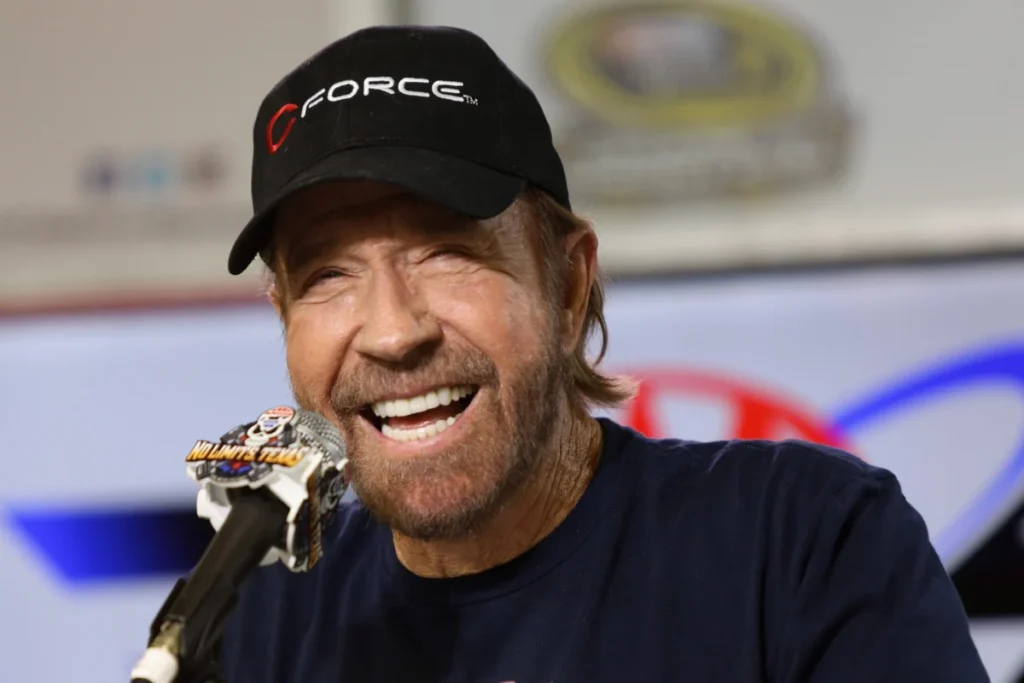

The world of martial arts, action cinema, and pop culture mourns the passing of Chuck Norris, the legendary champion-turned-actor, who died on Thursday at the age of 86 after being hospitalized in Hawaii. The news, which broke on Friday, prompted an immediate outpouring of tributes from across Hollywood, the political spectrum, and millions of fans worldwide, all reflecting on the profound impact of a man whose name became synonymous with strength, discipline, and an indomitable spirit.
Norris’s family confirmed his death in a statement, choosing to keep the specific circumstances private but assuring the public that he was "surrounded by his family and was at peace." Their heartfelt message underscored his life’s guiding principles: "He lived his life with faith, purpose, and an unwavering commitment to the people he loved. Through his work, discipline, and kindness, he inspired millions around the world and left a lasting impact on so many lives." The family expressed deep gratitude for the love and support Norris received from his global fanbase, noting, "To him, you were not just fans, you were his friends."
From Humble Beginnings to Martial Arts Mastery
Born Carlos Ray Norris in Ryan, Oklahoma, on March 10, 1940, Chuck Norris’s early life was marked by challenges, including a difficult childhood and frequent moves. After graduating from high school, he enlisted in the United States Air Force in 1959, a decision that would irrevocably alter the course of his life. While stationed at Osan Air Base in South Korea, he began training in Tang Soo Do, a Korean martial art. This introduction sparked a lifelong passion and revealed a natural talent that would soon elevate him to unprecedented heights.
Upon returning to the U.S., Norris continued his martial arts training with relentless dedication, eventually earning black belts in multiple disciplines, including Tang Soo Do, Brazilian Jiu-Jitsu, and Judo. He opened a chain of martial arts schools, attracting numerous students and building a formidable reputation within the burgeoning American martial arts scene. His competitive career was nothing short of legendary. From 1968 to 1974, Norris was the undisputed World Professional Middleweight Karate Champion, retiring undefeated. His precise, powerful, and often innovative fighting style revolutionized the sport and inspired countless individuals to take up martial arts themselves. He was a pioneering figure, instrumental in bringing martial arts into mainstream American consciousness. In 1990, he founded the United Fighting Arts Federation (UFAF), an organization dedicated to promoting martial arts education and character development.
The Transition to Stardom: A Bruce Lee Connection and Steve McQueen’s Encouragement
Norris’s transition from martial arts champion to international film star was serendipitous, aided by a friendship with Hollywood icon Steve McQueen, who was one of Norris’s martial arts students. McQueen recognized Norris’s unique charisma and formidable physical presence, reportedly encouraging him to pursue acting.
Norris’s cinematic debut came with a minor, uncredited role in the 1969 film The Wrecking Crew. However, it was his pivotal role as the formidable antagonist Colt in Bruce Lee’s 1972 martial arts classic Way of the Dragon (also known as Return of the Dragon) that truly launched his acting career. The climactic battle between Norris and Lee in the Roman Colosseum remains one of the most iconic fight sequences in cinematic history, showcasing Norris’s incredible skill and establishing him as a powerful on-screen presence capable of holding his own against the era’s biggest martial arts star. This role, while as a villain, cemented his reputation and opened doors in Hollywood.
Following Way of the Dragon, Norris began to secure lead roles, gradually carving out his niche as an action hero. Films like Good Guys Wear Black (1978), his first starring vehicle, and The Octagon (1980) demonstrated his box office potential, appealing to audiences drawn to his stoic demeanor and authentic martial arts prowess.
The 1980s Action Icon: From Vietnam Vets to Delta Force
The 1980s proved to be Norris’s golden decade in action cinema, where he became a cornerstone of the genre, particularly for Cannon Films, a prolific independent studio. His films often featured themes of patriotism, justice, and the fight against overwhelming odds, resonating deeply with audiences seeking escapist action and clear-cut heroism.
A defining moment in his film career came with the Missing in Action trilogy. The original 1984 film, Missing in Action, saw Norris portray Colonel James Braddock, a U.S. Army Special Forces officer who returns to Vietnam to rescue American prisoners of war. Released during a period of renewed public interest in the Vietnam War and its aftermath, the film tapped into a national sentiment of unresolved grievances and the desire for a hero who would take matters into his own hands. Despite mixed critical reception, the film was a significant commercial success, grossing over $22 million domestically and solidifying Norris’s status as a top-tier action star. It was followed by a 1985 prequel, Missing in Action 2: The Beginning, detailing Braddock’s own harrowing captivity, and a 1988 sequel, Braddock: Missing in Action III. The trilogy became synonymous with Norris’s brand of unwavering heroism and determination.
Other notable films from this era further cemented his legacy. Invasion U.S.A. (1985) saw him defend America from a Soviet-led invasion, while The Delta Force (1986), co-starring Lee Marvin, depicted a daring rescue mission against terrorists. These films, characterized by their high-octane action, clear moral lines, and Norris’s signature roundhouse kicks, resonated with audiences worldwide, establishing him as a global action superstar. Unlike many of his contemporaries who relied on elaborate stunts and special effects, Norris’s appeal lay in his grounded, authentic martial arts background, lending a visceral realism to his fight sequences.
Walker, Texas Ranger: A Television Phenomenon and Pop Culture Icon
While his film career was robust, it was his starring role in the CBS television series Walker, Texas Ranger that cemented Chuck Norris’s image as an enduring cultural icon for a new generation. Premiering in 1993, the series cast Norris as Cordell Walker, an incorruptible Texas Ranger, martial arts expert, and a man of deep moral conviction who fought crime with a unique blend of physical prowess and unwavering ethical principles.
Walker, Texas Ranger became a ratings juggernaut, running for eight successful seasons until 2001, and enjoying extensive global syndication. Its success was largely attributed to Norris’s relatable persona, the show’s family-friendly themes, and its consistent portrayal of justice triumphing over evil. The series not only showcased Norris’s martial arts skills but also allowed him to develop a more nuanced character, often tackling social issues alongside high-stakes action. The show’s popularity was so immense that it spawned a television movie, Walker, Texas Ranger: Trial by Fire, in 2005.
The widespread appeal of Walker, Texas Ranger also gave rise to a unique cultural phenomenon: the "Chuck Norris facts." These exaggerated, often humorous, and hyper-masculine claims about Norris’s superhuman abilities ("Chuck Norris doesn’t do push-ups, he pushes the Earth down," "Chuck Norris counted to infinity… twice") began circulating on the internet in the early 2000s. Far from being detrimental, these viral memes further amplified his legendary status, blending reality with playful hyperbole and introducing his persona to an even broader, digitally native audience. The "Chuck Norris facts" became a testament to his enduring power as a symbol of ultimate toughness and resilience.
Philanthropy, Faith, and Political Engagement
Beyond his cinematic and television achievements, Chuck Norris was deeply committed to philanthropy and public service. In 1990, he founded the "Kickstart Kids" program, a non-profit organization dedicated to teaching martial arts and character development to middle school students at risk of substance abuse and gang involvement. The program, which operates in numerous schools across Texas, aims to instill values like respect, discipline, and self-control, using martial arts as a vehicle for personal growth and empowerment. This initiative reflected Norris’s belief in the transformative power of martial arts, not just as a physical discipline but as a tool for building strong character.
Norris was also an outspoken advocate for conservative political causes and a devout Christian, often integrating his faith into his public persona and work. He supported various political campaigns and spoke on issues he felt strongly about, earning him respect among conservative circles. His image as a steadfast, principled, and patriotic figure resonated with a significant segment of the American public.
A Global Outpouring of Tributes: From Hollywood Peers to World Leaders
The news of Chuck Norris’s passing elicited a widespread and heartfelt response from a diverse array of public figures, underscoring his broad and multifaceted impact.
Fellow action stars were quick to share their condolences and memories. Sylvester Stallone, who starred alongside Norris in The Expendables 2, took to Instagram, writing that he "had a great time working with" Norris and praised him as "All American in every way." Dolph Lundgren, another colleague from The Expendables franchise, shared a photo and expressed that he "always looked up to [Norris] as a role model," noting his "respect, humility and strength." Gina Carano, a mixed martial artist and actress, simply stated on X, "Rest in peace to a great man, there will never be anyone like him." Lorenzo Lamas added a poignant and humorous tribute, referencing the "Chuck Norris facts" by writing, "Chuck Norris doesn’t just get wings, he gets even." Actor Joe Piscopo called working with Norris "a life changing and treasured experience."
The tributes extended beyond the action genre. Renowned author Stephen King, known for his horror novels, shared some of his favorite "Chuck Norris jokes" before seriously adding on X, "Seriously, I thought he was great. SILENT RAGE scared hell out of my boys…and me." This acknowledgment from a literary giant highlighted Norris’s unexpected reach into different cultural spheres. Media personality Glenn Beck also paid tribute, cleverly incorporating a "Chuck Norris fact" into his message: "Also, in breaking news, the Grim Reaper was found dead after attempting to take Chuck Norris to the afterlife."
Political leaders also honored Norris, reflecting his influence beyond entertainment. Texas Governor Greg Abbott praised him as a "legend," stating, "All of Texas mourns the passing of Chuck Norris. He was not only a martial arts champion, action icon, and the one and only Walker, Texas Ranger, but he electrified generations of conservatives, giving them a passion and voice to fight for the principles that make America the greatest nation on earth. He embodied the toughness, grit, and patriotism that makes Texas supreme." Former Arkansas Governor Mike Huckabee expressed his deep sadness, calling Norris an "amazing American icon."
Perhaps one of the most unexpected yet significant tributes came from Israeli Prime Minister Benjamin Netanyahu, who shared a photo of himself with Norris, describing him as a "close personal friend" and "a great friend of Israel." Netanyahu’s message, "Chuck brought martial arts and the warmth of his character to millions around the world. May his memory be a blessing," underscored Norris’s international appeal and diplomatic reach.
A Legacy of Unwavering Resolve
Chuck Norris’s passing marks the end of an era, but his legacy is indelible. He was more than just an actor or a martial artist; he was a cultural phenomenon whose image transcended his professional achievements. He inspired millions to pursue martial arts, entertained countless more with his stoic heroics, and became a symbol of unwavering strength and moral integrity in an increasingly complex world.
His career trajectory, from a disciplined martial artist to a beloved action hero and later a philanthropic advocate, demonstrates a life lived with consistent purpose and dedication. The "Chuck Norris facts," while humorous, are a testament to how deeply his persona resonated with the public, transforming him into a larger-than-life figure. His commitment to his faith, his family, and his country, as well as his efforts to empower youth through programs like Kickstart Kids, painted a portrait of a man who genuinely sought to make a positive impact.
As the world remembers Chuck Norris, the tributes paint a consistent picture: a man of immense physical talent, profound character, and a quiet dignity that belied his on-screen toughness. He carved a unique niche in Hollywood and beyond, leaving behind a body of work that will continue to inspire and entertain for generations to come. His family’s message of peace and purpose, reflecting his own life, serves as a fitting epitaph for a true legend.