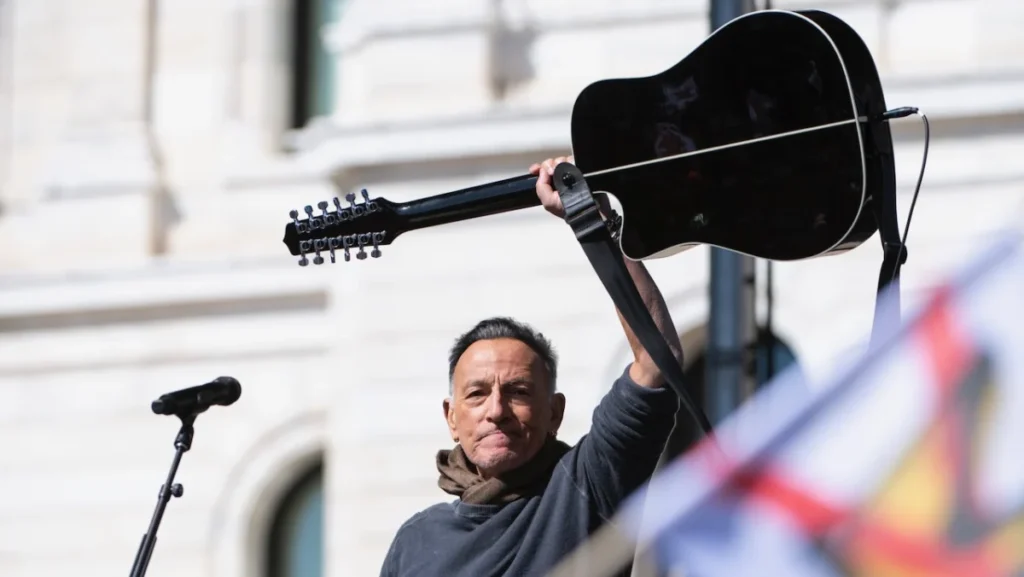

Minneapolis, MN – Legendary rock icon Bruce Springsteen made a powerful and poignant appearance at the "No Kings" protest in Minneapolis on Saturday, March X, 2026, delivering a galvanizing speech and performing his recently penned anthem, "Streets of Minneapolis." The song was written in direct response to the tragic fatal shootings of Renee Good and Alex Pretti by Immigration and Customs Enforcement (ICE) agents in the city earlier this year, an incident that ignited widespread outrage and fueled the burgeoning "No Kings" movement.
Springsteen, known for his decades-long commitment to social commentary and working-class anthems, lent his formidable voice to the demonstration, which drew thousands to the heart of Minneapolis. His presence underscored the national significance of the local tragedy and the broader implications of federal intervention in municipal affairs.
The Catalyst: Fatal ICE Shootings and Community Outcry
The roots of the "No Kings" protest trace back to the harrowing events of late January 2026, when two Minneapolis residents, Renee Good and Alex Pretti, were killed during an ICE operation. According to community accounts and statements from protest organizers, Renee Good, a mother of three, was "brutally murdered," and Alex Pretti, a dedicated VA nurse, was "executed by ICE," reportedly "shot in the back and left to die in the street." These accounts paint a grim picture of federal agents acting with excessive force, leaving a profound scar on the community and raising serious questions about accountability and oversight.
The immediate aftermath of the shootings was characterized by a potent mix of grief, anger, and a demand for justice. Local authorities and community leaders expressed dismay, with many calling for independent investigations into the conduct of the ICE agents involved. However, the original article indicates that the government’s response was deemed inadequate, with Springsteen later stating, "without even the decency of our lawless government investigating their deaths." This perceived lack of official transparency and accountability became a critical rallying point for residents and activists, who felt their city had been violated by an external, unaccountable force.
The Genesis of the "No Kings" Movement
In the wake of the shootings, a grassroots coalition swiftly emerged, coalescing under the banner of the "No Kings" movement. The name itself, "No Kings," symbolically rejects authoritarian power and asserts local sovereignty against what activists perceive as federal overreach and unchecked authority. The movement’s core demands include:
- Independent investigation and prosecution: For the ICE agents involved in the deaths of Renee Good and Alex Pretti.
- Cessation of ICE operations in Minneapolis: A call for federal immigration enforcement to cease its activities within the city’s jurisdiction, advocating for local control over immigration matters.
- Protection of civil liberties: A broader plea for the safeguarding of residents’ rights against what is viewed as an increasingly militarized and aggressive federal presence.
- Community empowerment: Reinforcing the idea that local communities should dictate the terms of their safety and governance, free from external, unaccountable forces.
The "No Kings" movement quickly gained traction, organizing vigils, community meetings, and smaller protests throughout February and early March. Social media campaigns amplified their message, drawing attention from across the country and highlighting Minneapolis as a flashpoint in the ongoing national debate about immigration enforcement, federal power, and civil rights. The protest on Saturday was intended to be the movement’s largest demonstration yet, designed to escalate pressure on both federal and local governments.
Springsteen’s Resonant Message and Performance
Against this backdrop of heightened tension and determined activism, Bruce Springsteen’s decision to participate in the "No Kings" protest was a significant moment. Taking the stage amidst a fervent crowd, Springsteen delivered a brief but impassioned address that resonated deeply with the spirit of the movement.
"This past winter, federal troops brought death and terror to the streets of Minneapolis, but they picked the wrong city," Springsteen declared, his voice cutting through the Minneapolis air. "The power and the solidarity of the people of Minneapolis and Minnesota was an inspiration to the entire country. Your strength and your commitment told us that this is still America, and this reactionary nightmare – and these invasions of American cities – will not stand. You gave us hope, you gave us courage."
His words not only acknowledged the pain and anger felt by the community but also elevated their struggle to a national narrative of resistance against perceived authoritarianism. By calling the federal actions an "invasion" and a "reactionary nightmare," Springsteen aligned himself squarely with the protesters’ perspective, framing the events as an attack on fundamental American values.
He then paid tribute to the victims, ensuring their names would not be forgotten. "And for those who gave their lives: Renee Good, mother of three, brutally murdered. Alex Pretti, VA nurse, executed by ICE. Shot in the back and left to die in the street without even the decency of our lawless government investigating their deaths. Their bravery, their sacrifice, and their names will not be forgotten." This direct naming and recounting of the circumstances of their deaths served as a powerful act of remembrance and a challenge to the official silence surrounding the incidents.
Following his speech, Springsteen performed "Streets of Minneapolis," a song he composed specifically in response to the shootings. While the full lyrics were not disclosed in the original report, the title itself suggests a narrative focus on the city’s struggle and the impact of the events on its inhabitants. Springsteen’s songwriting often blends personal narratives with broader societal critiques, and "Streets of Minneapolis" is expected to become another powerful entry in his extensive catalog of protest songs. The live video footage of the performance, accessible via the provided YouTube embed, captures the raw emotion and collective solidarity of the moment, with the crowd responding viscerally to his powerful vocals and guitar.
Springsteen’s Enduring Activism and Motivation
Bruce Springsteen’s appearance in Minneapolis is consistent with a career spanning over five decades, marked by a deep engagement with social justice issues and the struggles of ordinary Americans. From early anthems like "Born in the U.S.A.," which subtly critiqued the post-Vietnam American dream, to later works addressing economic disparity, war, and political disillusionment, Springsteen has consistently used his platform to advocate for the marginalized and challenge established power structures. His performance at the "No Kings" protest is a continuation of this legacy, demonstrating his willingness to "meet the moment," as he articulated in a recent interview.
In an interview with the Star Tribune earlier in the week, Springsteen elaborated on his motivation for joining the protest. "You want to try to meet the moment," he explained. "The No Kings movement is of great import right now. When you have the opportunity to sing something where the timing is essential and if you have something powerful to sing, it elevates the moment, it elevates your job to another level. And I’m always in search of that." This statement highlights his artistic philosophy: to create and perform music that not only entertains but also resonates with and empowers communities facing adversity, transforming a musical performance into an act of solidarity and resistance.
His presence, therefore, was not merely a celebrity endorsement but a deeply considered artistic and political statement, leveraging his unique ability to connect with mass audiences and articulate profound societal concerns.
Broader Context: Federal Overreach and Local Resistance
The "No Kings" protest and Springsteen’s involvement fit into a broader national narrative concerning federal authority, particularly regarding immigration enforcement. Over recent years, there has been increasing tension between federal agencies like ICE and local jurisdictions, many of which have adopted "sanctuary" policies or expressed reluctance to cooperate with federal immigration efforts. This tension often escalates into legal battles and, in some cases, direct confrontations like the one that tragically unfolded in Minneapolis.
Critics of federal overreach argue that such aggressive tactics erode public trust, foster fear within immigrant communities, and undermine the principles of local governance. Proponents of robust federal enforcement, on the other hand, often cite national security concerns and the imperative of upholding immigration laws. The Minneapolis incident, however, appears to have transcended the typical immigration debate, focusing instead on the perceived brutality and lack of accountability by federal agents operating within a sovereign city.
Minneapolis, in particular, has a history of robust civic engagement and social activism. From its role in the labor movement to its recent prominence in national conversations about racial justice and policing, the city has often been at the forefront of movements advocating for civil rights and community empowerment. The "No Kings" movement is thus deeply rooted in this local tradition of resistance, finding common ground with other struggles against systemic injustices.
Implications and Future Outlook
Bruce Springsteen’s appearance at the "No Kings" protest carries several significant implications. Firstly, it provides a massive boost in visibility and legitimacy for the movement. A celebrity of Springsteen’s stature commands international media attention, elevating a local protest to a national, if not global, stage. This increased exposure can pressure policymakers at both federal and local levels to address the movement’s demands more seriously.
Secondly, his powerful rhetoric, particularly his condemnation of "invasions of American cities" and "lawless government," is likely to galvanize supporters and potentially inspire similar resistance movements in other cities facing perceived federal overreach. It frames the struggle not just as a local issue but as a defense of fundamental American liberties against an encroaching "reactionary nightmare."
Thirdly, the incident and Springsteen’s response could further fuel the ongoing national debate about the role and accountability of federal agencies, particularly those involved in law enforcement and immigration. It adds a potent emotional and artistic dimension to an often-impersonal policy discussion.
Looking ahead, Springsteen’s connection to Minneapolis will continue as he is scheduled to remain in the city through Tuesday, when he will kick off the "Land of Hope and Dreams" tour with the E Street Band at the Target Center. This 20-date tour, also featuring stops in major cities like Boston, Chicago, Los Angeles, New York, and Washington, D.C., will inevitably carry the echoes of his Minneapolis protest. Each concert will be an opportunity for Springsteen to reiterate his message of hope, courage, and resistance, potentially incorporating "Streets of Minneapolis" into his setlist, thus carrying the story of Renee Good and Alex Pretti to audiences across the nation. The tour, named after one of his anthems of resilience, takes on new layers of meaning in the context of his direct participation in the "No Kings" movement, solidifying his role not just as a musician but as a steadfast voice for justice and human dignity. Tickets for the tour are available for purchase via StubHub.