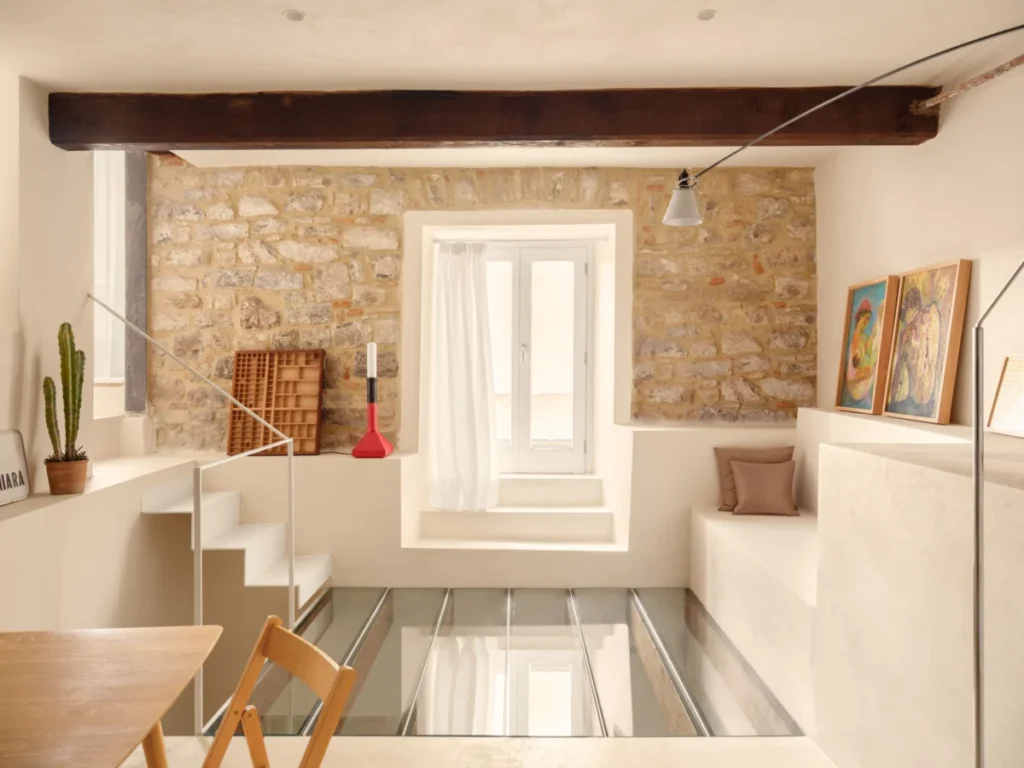

In the historic heart of Imperia, a coastal city in Italy’s picturesque Liguria region, a 592-square-foot structure that was once dismissed as a damp, hopeless ruin has been reborn as a sophisticated contemporary residence. The project, led by architect Davide Andracco, represents a masterclass in historical preservation and spatial efficiency. Located in the Parasio district, the oldest part of the city, the home dates back to the 17th century and serves as a testament to the enduring nature of Mediterranean stone architecture. Despite the skepticism of the local community and the initial doubts of the homeowner—a Swiss teacher seeking a retreat on the Italian Riviera—Andracco saw the potential for a transformative design that honors the past while embracing modern minimalism.
The renovation of this modest property, which lacks the grand proportions of a Venetian palazzo but possesses the rugged charm of a traditional Ligurian dwelling, highlights a growing trend in European architecture: the reclamation of abandoned urban cores. In Parasio, characterized by a labyrinth of narrow streets known as caruggi and steep staircases overlooking the Ligurian Sea, such projects are fraught with logistical challenges, including strict conservation laws and the difficulty of transporting materials through ancient, pedestrian-only thoroughfares.

Architectural Vision and the Challenge of the Parasio District
The Parasio district is a site of significant cultural heritage, largely untouched by the mass tourism that has transformed other parts of the Italian Riviera, such as Portofino or the Cinque Terre. The architecture here is defined by its verticality, a direct response to the limited land available on the promontory. When Davide Andracco first encountered the property, it was an abandoned shell, suffering from centuries of neglect and significant moisture issues.
"It was in really bad shape, but I sensed its potential," Andracco noted during the project’s unveiling. The client’s initial skepticism was rooted in the property’s dilapidated state. However, the architect’s vision centered on two primary goals: the maximization of natural light and the creative exploitation of the building’s vertical volume. Because the historic center of Imperia prohibits external additions or structural expansions to existing buildings, Andracco had to look inward and downward to find more space.
A Chronology of Discovery: Uncovering the Hidden Layers
The restoration process was marked by several significant architectural discoveries that fundamentally altered the project’s trajectory. The first major find occurred during the initial excavation and floor stabilization phase. Workers uncovered a large, waterproof underground cistern. In the 17th century, such tanks were essential for collecting rainwater in hilltop villages where access to fresh springs was limited.

Rather than filling the void, Andracco integrated the cistern into the living space. By excavating this area, the firm gained critical headroom that allowed for a multi-leveled floor plan. This space was transformed into a quiet, subterranean study, offering a cool sanctuary during the intense heat of the Italian summer. This discovery provided a solution to the "no additions" rule, effectively increasing the usable square footage by utilizing the building’s existing subterranean footprint.
A second discovery occurred at the entrance of the building. While planning the kitchen layout, Andracco noticed an unusual slope in the ceiling. Investigation revealed a previously walled-off cavity above the entrance. This "bonus" space was promptly incorporated into the design as a mezzanine loft, now serving as a versatile area for a bed or a desk. These discoveries illustrate the "archaeological" nature of renovating 17th-century structures, where the building’s history often dictates the final floor plan.
Spatial Engineering: Six Levels in 592 Square Feet
The most striking feature of the completed renovation is the complex interplay of vertical levels. Within a footprint of less than 600 square feet, Andracco managed to incorporate six distinct elevations. The experience of moving through the home has been described as navigating an architectural "roller coaster" or an M.C. Escher drawing brought to life.

The journey begins at the entry, situated slightly below street level. From there, the floor plan unfolds as follows:
- The Entry and Kitchen: A suspended platform that provides an immediate view of the home’s vertical depth.
- The Living Area: A descent into the main social space, featuring an original structural column.
- The Subterranean Study: A further descent into the former water cistern.
- The Sleeping Loft: An ascent to the space discovered above the kitchen.
- The Transition Platform: A mid-level area connecting the social and private zones.
- The Bathroom: A final turn at the highest point of the apartment’s circulation path.
To maintain a sense of cohesion across these fragmented levels, Andracco employed a restricted material palette. Exposed stone walls and original chestnut beams provide a warm, textural backdrop, while modern elements—such as a sofa carved directly from a masonry block and metal staircases fabricated by Gre.Mo Carpenteria In Ferro—introduce a contemporary edge. The custom woodwork, provided by BF Mobili, was designed to fit into the irregular nooks and crannies typical of ancient masonry.
Materiality and the Integration of Barite Stones
The renovation also reflects the personal philosophy and health concerns of the homeowner. A unique aspect of the project was the inclusion of Barite stones, specially imported from Switzerland at the client’s request. Barite (barium sulfate) is a dense mineral known in industrial contexts for its ability to shield against X-rays and gamma radiation. In the context of this home, the stones were embedded in a cemented strip near the living room window to serve as a perceived shield against environmental radiation.

Beyond the physical properties of the mineral, the client’s request touched upon metaphysical themes. In certain spiritual traditions, Barite is believed to assist in the alignment of the chakras and the enhancement of intuitive abilities. While Andracco approached this addition from a design perspective—seamlessly hiding the stones within the masonry—he acknowledged that these personal touches contribute to the home’s atmosphere of "calm silence" and refuge.
Supporting Data: The Economics of Restoration in Liguria
The project reflects a broader economic shift in the Ligurian real estate market. According to recent data from Italian property portals, demand for "rustic" properties in historic centers has seen a 12% increase among foreign buyers, particularly from Switzerland, Germany, and Northern Europe. These investors are often drawn to the "Slow Tourism" movement, which prioritizes authentic cultural experiences over traditional luxury resorts.
The cost of renovating a 17th-century ruin in a historic center like Parasio can be significantly higher than new construction, often ranging from €2,000 to €3,500 per square meter, depending on the state of the original structure and the complexity of the preservation requirements. However, the value of such properties often doubles upon completion, as they offer a unique combination of historical prestige and modern interior design that cannot be replicated in new developments.

Broader Impact and Implications for Urban Preservation
The success of Davide Andracco’s project has implications for urban planners and architects working in Italy’s thousands of "borghi" (historic villages). As modern populations gravitate toward larger cities, many ancient town centers face the threat of abandonment and decay. This project demonstrates that even the most "hopeless" ruins can be salvaged through creative engineering and a deep respect for architectural history.
The use of verticality and the repurposing of historical infrastructure (like the cistern) offer a blueprint for densifying historic areas without altering their external appearance. This approach aligns with the European Union’s "Green Deal" initiatives, which emphasize the renovation of existing building stock to improve energy efficiency and reduce the environmental impact of new construction.
Furthermore, the project highlights the importance of the architect-client relationship. Andracco’s ability to convince a skeptical client to invest in a damp, abandoned shell was predicated on a shared vision of what "luxury" means in the 21st century. In this context, luxury is not defined by vast square footage or gold-plated fixtures, but by the clever use of space, the abundance of natural light, and a tangible connection to the layers of history embedded in the stone walls.

Conclusion: A Modern Refuge in an Ancient Setting
The completed home in Parasio stands as a quiet triumph of design over circumstance. By embracing the irregularities of the 17th-century structure—the sloped ceilings, the hidden voids, and the damp foundations—Davide Andracco has created a space that feels both ancient and avant-garde. The intervention serves as a reminder that the preservation of heritage is not merely about maintaining the status quo, but about reimagining the past to serve the needs of the present.
For the Swiss teacher who now calls this 592-square-foot "roller coaster" her home, the result is a perfect refuge. The project proves that with sufficient vision, even the most neglected corners of Italy’s historic landscape can be transformed into vibrant, functional, and deeply personal spaces. As the morning sun streams through the windows of the Parasio apartment, illuminating the original brickwork and the hidden Barite stones, the home stands as a beacon of what is possible when architecture listens to the stories told by the ruins.