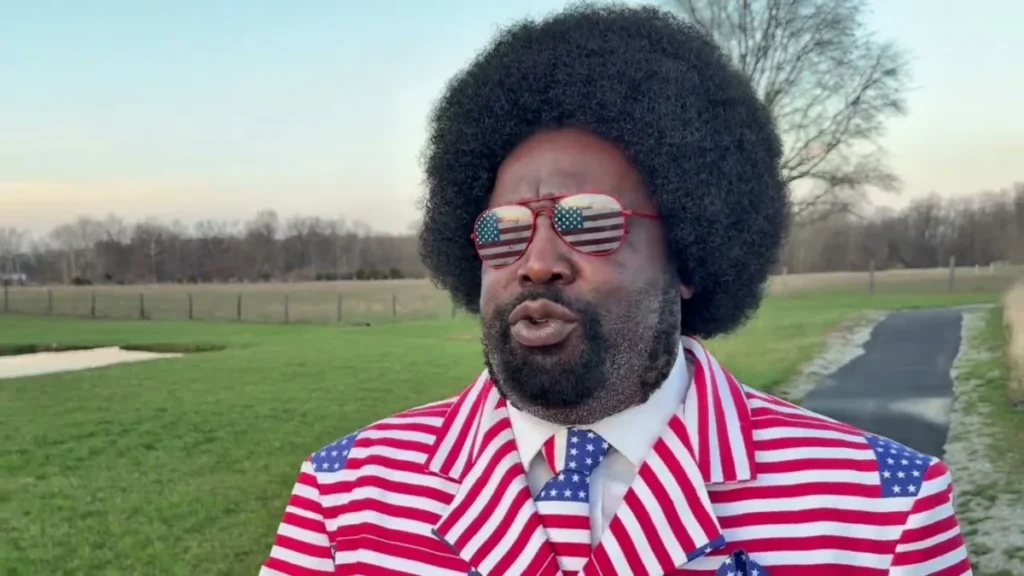

Joseph Edgar Foreman, known globally as Afroman, has marked a significant legal triumph with the release of his new track, “Batteram Hymn of the Police Whistleblower.” The song serves as both a celebration and a detailed, albeit satirical, account of his recent victory in a civil lawsuit brought against him by several deputies from the Adams County Sheriff’s Department in Ohio. This musical retort follows a jury’s decision to clear Afroman of all charges, affirming his right to free speech and artistic expression in the face of allegations of defamation and invasion of privacy.
The Verdict: A Resounding Affirmation of Free Speech
Last week, a jury delivered a verdict in favor of Afroman, concluding a civil lawsuit that had drawn considerable public and legal attention. The lawsuit, initiated by four deputies, two sergeants, and one detective from the Adams County Sheriff’s Department, alleged that Afroman’s music videos and public commentary following a raid on his home caused them "emotional distress, embarrassment, ridicule, loss of reputation, and humiliation." However, the jury, after less than a day of deliberation, found Afroman not liable on any of the claims, effectively validating his artistic response to what he maintained was an unwarranted intrusion.
This legal outcome is seen by many as a critical affirmation of First Amendment rights, particularly concerning the ability of citizens, including artists, to critique public officials and governmental actions. The swiftness of the jury’s decision underscores the challenge faced by public figures, including law enforcement officers, in proving defamation or invasion of privacy when their actions become subjects of public scrutiny and artistic commentary.
Genesis of the Conflict: The 2022 Home Raid
The roots of the lawsuit trace back to an incident in August 2022, when law enforcement officers from the Adams County Sheriff’s Department conducted a raid on Afroman’s home. The operation was reportedly based on unsubstantiated suspicions of drug trafficking and kidnapping. According to Afroman and subsequent legal proceedings, the raid yielded no evidence to support these serious allegations, leaving his property damaged and his privacy violated.
In the immediate aftermath, Afroman leveraged his platform and artistic medium to respond. Utilizing footage from his home security cameras, he produced several music videos that directly addressed the raid and the officers involved. One notable track, “Lemon Pound Cake,” became a viral sensation, accumulating over three million views to date. These videos, which incorporated the actual security footage of the raid, depicted officers searching his home, interacting with his family, and, in his view, acting beyond the scope of their authority. It was these visual and lyrical critiques that ultimately formed the basis of the deputies’ lawsuit.
Afroman’s Artistic Retaliation and the Lawsuit’s Filing
Afroman’s decision to use his art as a form of protest and documentation was a direct challenge to the perceived overreach of the law enforcement action. His videos, beyond “Lemon Pound Cake,” specifically named and depicted the officers involved, transforming a private grievance into a public spectacle and a critique of police conduct. This approach, while resonant with many advocates for police accountability, was interpreted by the plaintiffs as a direct attack on their professional and personal reputations.
In March 2023, the seven law enforcement officers filed their civil suit against Afroman, contending that his videos constituted defamation—the false communication of a statement that harms the reputation of an individual—and invasion of privacy, specifically the public disclosure of private facts and the appropriation of their likenesses without consent. They sought damages for the purported emotional distress and reputational harm, arguing that Afroman’s widespread dissemination of the footage and his accompanying lyrical content had subjected them to unwarranted ridicule and public scorn. The legal battle that ensued became a high-profile test case, pitting artistic freedom against the personal rights of public servants.
"Batteram Hymn of the Police Whistleblower": A Musical Deposition
In the wake of his legal victory, Afroman wasted no time in unveiling “Batteram Hymn of the Police Whistleblower.” The five-minute track is a comprehensive, if irreverent, musical recounting of the entire legal saga, delivered in the distinctive style that has characterized his career. Donning the same patriotic American flag suit he wore during his court appearances, Afroman uses the song to detail the court proceedings, the various legal figures involved, and his interpretation of events.
The song is unequivocally a diss track, but one crafted with a specific legal and narrative purpose. It features a janky guitar appropriation of the iconic “Battle Hymn of the Republic,” infusing the solemn melody with a sense of comedic defiance. Afroman pulls no punches, directing his lyrical barbs at various targets within the Adams County legal system. He notably likens Judge Roy E. Gabbert to the cartoon character Droopy, a comparison intended to diminish the judge’s perceived authority or effectiveness. Prosecutor David Kelly is also singled out for allegedly “turning to jelly” during court proceedings, a claim aimed at questioning the prosecution’s resolve and performance. Furthermore, Afroman reiterates his assertion that sheriff’s deputies stole money during the raid, a claim central to his grievance and implied in his earlier videos.
Accompanying the video for the new song, Afroman provided a written statement that encapsulates his perspective on the entire ordeal: “Unconfidential informant lied to Police to get out of some trouble Adam County Sheriff officers made a mistake by believing the lie Raided my house found nothing refused to pay for the damages and filed a lawsuit against me Afroman for exercising my freedom of speech! This is me holding trial in one song. I hope you enjoy it.” This statement succinctly outlines his defense: a flawed initial premise for the raid, the failure to find incriminating evidence, the refusal to compensate for damages, and the subsequent lawsuit as an attempt to stifle his constitutional right to free speech.
The Legal Landscape: First Amendment Protections and Public Figures
The outcome of Afroman’s lawsuit underscores fundamental principles of American jurisprudence, particularly the interplay between the First Amendment and defamation law. For public figures, which can include law enforcement officers acting in their official capacity, the legal standard for proving defamation is significantly higher than for private individuals. To succeed in such a claim, plaintiffs must not only prove that the statements made were false and damaging but also that they were made with "actual malice"—meaning the speaker knew the statements were false or acted with reckless disregard for their truth or falsity.
In cases involving matters of public concern, such as alleged police misconduct, the courts generally afford broad protection to speech, even if it is critical or unflattering. Afroman’s use of security footage from his own home, combined with his artistic commentary, likely fell under this protected umbrella. The jury’s rapid decision suggests they did not find sufficient evidence of actual malice or that Afroman’s depictions constituted an actionable invasion of privacy given the context of public interest in police actions.
Furthermore, the concept of qualified immunity often shields government officials from liability in civil lawsuits unless their conduct violates clearly established statutory or constitutional rights, and there is no reasonable belief that their actions were lawful. While this case was a civil suit against Afroman, the underlying conduct of the police raid and the subsequent artistic response inherently touch upon these principles of government accountability and citizen rights.
Implications for Police Accountability and Citizen Oversight
Afroman’s victory carries significant implications for the ongoing national dialogue surrounding police accountability and citizen oversight. In an era where body cameras and personal devices increasingly capture interactions between law enforcement and the public, the ability of citizens to document, share, and critique these interactions is paramount. This verdict may empower individuals and artists to continue using their platforms to expose what they perceive as abuses of power without fear of legal retaliation, provided their expressions meet the high bar of protected speech.
The case also highlights the evolving nature of public scrutiny on law enforcement. Police departments across the country face increasing demands for transparency and accountability, particularly in the execution of warrants and raids. Unfounded raids, such as the one described by Afroman, erode public trust and fuel skepticism regarding police operations. A verdict like this sends a clear message that law enforcement actions, especially those that intrude upon private citizens’ lives, are subject to public commentary and artistic interpretation, and attempts to silence such critique through litigation may not succeed.
Artistic Freedom and Satire in the Digital Age
The case also serves as a poignant example of artistic freedom in the digital age. Afroman, known for his humorous and often irreverent takes on everyday life and societal issues, utilized his unique musical voice to transform a personal trauma into a public statement. His song "Because I Got High" became a cultural phenomenon, demonstrating his ability to connect with a broad audience through relatable narratives. In this instance, he harnessed that ability to address a serious personal and civic issue.
Satire and parody have long been recognized as protected forms of speech, serving as vital tools for social commentary and critique. By parodying a well-known patriotic hymn and employing hyperbole and caricature in his lyrics, Afroman engaged in a form of political and social satire. The jury’s decision reinforces the notion that even harsh or uncomfortable criticism, when presented within an artistic or satirical context, often falls within the bounds of protected expression. This precedent encourages artists to continue challenging authority and sparking public discourse through their creative works, even when those works target powerful institutions or individuals.
Conclusion
Afroman’s legal victory against the Adams County Sheriff’s deputies is more than just a personal triumph; it is a significant moment for artistic freedom and citizen oversight in the United States. His new song, “Batteram Hymn of the Police Whistleblower,” stands as a testament to his resolve and a creative embodiment of his vindication. By turning a personal ordeal into a public anthem, Afroman has not only celebrated his legal win but also contributed to the ongoing national conversation about police accountability, the First Amendment, and the enduring power of artistic expression to challenge authority. The verdict sends a clear message that while law enforcement officers perform critical public duties, their actions remain subject to public scrutiny and the robust protections afforded by the U.S. Constitution.