
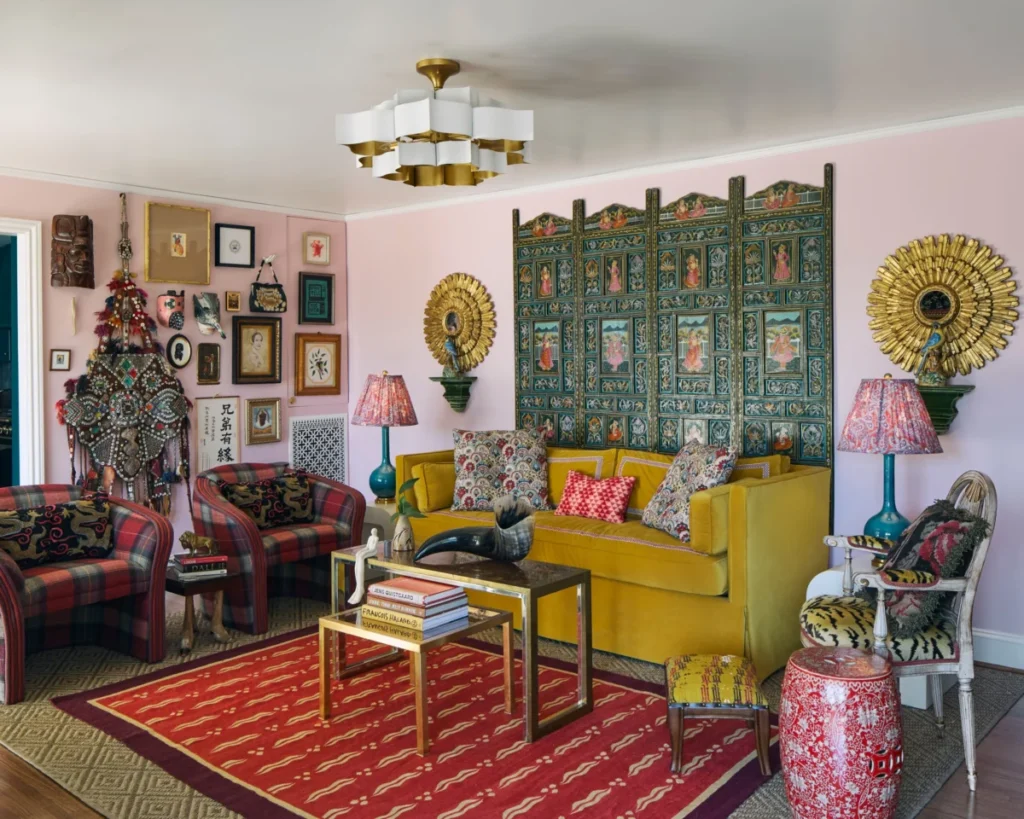

In the affluent suburb of Mountain Brook, Alabama, a residential renovation has recently concluded, transforming a standard mid-century structure into a vibrant, maximalist sanctuary. Spearheaded by Birmingham-based designer Danielle Balanis, the project demonstrates a departure from the neutral palettes that have dominated American interior design for the past decade. The catalyst for this aesthetic overhaul was a single 1960s portrait by famed photographer Slim Aarons, featuring rock legend Mick Jagger and his then-partner Marianne Faithfull. This photograph, discovered during the early stages of the design process, served as the tonal and atmospheric blueprint for what would become a three-bedroom home defined by deep jewel tones, complex pattern layering, and an unapologetic embrace of bohemian luxury.

The residence, a one-story ranch-style home built in the late 1960s, originally featured the traditional, somewhat utilitarian layout common for its era. However, the homeowners—a well-traveled couple with a young child—sought a living environment that reflected their personal history and global experiences rather than conforming to suburban architectural norms. By prioritizing "color and happiness" over market-driven resale considerations, the project has emerged as a case study in authentic, personalized interior architecture.
The Genesis of a Maximalist Narrative
The design journey began with a bold color choice in the heart of the home. One of the first major decisions was to coat the kitchen in a vibrant, saturated shade of peacock blue. According to Balanis, this specific move acted as a "north star" for the rest of the project. Once the kitchen’s intensity was established, the design took on a momentum of its own, expanding into a series of interconnected spaces that balance "runway glamour" with the practicalities of a family home.

Balanis, whose design philosophy often merges high-fashion influences with historic preservation, describes the aesthetic as a marriage of "runway and reality." This approach is particularly evident in the way the home handles transitions. Rather than utilizing open-concept minimalism, the house uses color and pattern to define distinct "chapters" of the living experience. The entrance hall and adjacent dining room, for instance, utilize optical illusions created through pattern layering. Marbled wallpaper from Pierre Frey is juxtaposed against wine-red painted paneling, while a large convex mirror in the hallway distorts and reflects these elements, creating a surrealist, immersive atmosphere upon entry.
Architectural Context and the 1960s Ranch
The choice of a 1960s ranch for such a radical transformation is significant within the context of American architectural history. The ranch house, or "rambler," became the dominant housing style in the United States during the post-World War II era, peaking in popularity during the 1950s and 60s. These homes were celebrated for their horizontal silhouettes and connection to the outdoors, but they are often criticized today for their repetitive layouts.

In Mountain Brook—a city known for its estate-style homes and traditional Southern architecture—the 1960s ranch offers a unique canvas for designers like Balanis. By retaining the original footprint and certain structural quirks, such as bifold storage cupboards, Balanis was able to ground the avant-garde interior in a recognizable historical context. Rather than removing the bifold doors, which would have been structurally intrusive, the design team applied wallpapered panels to them, transforming a dated utility into a handcrafted design feature.
A Room-by-Room Chronology of Color and Pattern
The progression through the home is designed to be a "sensorial experience," with each room offering a different mood while maintaining a cohesive thread of maximalism.

The Dining Room and Study
The dining room is framed by wide entrances painted in a deep jade green. Inside, the walls are adorned with Cowtan & Tout’s Rutland wallpaper, a romantic floral pattern that contrasts with vintage Lucite dining chairs sourced from Chairish. The chairs, featuring warm striped upholstery, introduce a 1970s "disco-chic" element that complements the 1960s architecture. Adjacent to this space, a study features bespoke green shelving that mirrors the jade trim of the dining room, ensuring a visual flow between the working and entertaining areas.
The Living Room and Global Artifacts
In the pink-toned living room, the design shifts toward a more global, "collected" feel. The space serves as a gallery for the owners’ travels. A vintage sofa and chairs are paired with an antique Indian painted screen. A standout feature is a tasseled asmalyk—a traditional camel trapping used in Turkmen wedding ceremonies—which hangs as part of a wall display. This inclusion highlights the homeowners’ desire to surround themselves with items that possess cultural and personal history.

The Primary Suite: The Jewel Box Effect
The primary bedroom is perhaps the most concentrated expression of the home’s color theory. Deep burgundy walls provide a somber, sophisticated backdrop for Beata Heuman’s Marbleized wallpaper. Balanis utilized a matching velvet fabric on various surfaces to create what she calls a "jewel box" effect. This technique of "color drenching"—where walls, trim, and even furniture share similar tones—is a hallmark of modern maximalism that aims to create a sense of enclosure and intimacy.
The Guest and Reading Room
The original inspiration for the home, the Slim Aarons portrait of Jagger and Faithfull, eventually found its permanent place in a reading room that doubles as a guest suite. The room is a playful composition of checkered Schumacher wallpaper, leopard-print carpeting, and an Avalon rattan daybed by Serena & Lily. The presence of the photograph in this specific room serves as a thematic bookend to the entire renovation process.

Supporting Data: The Resurgence of Maximalism
The Mountain Brook project reflects a broader shift in the interior design industry. According to market analysis from platforms like 1stDibs and Pinterest, "Maximalism" and "Cluttercore" (a curated version of maximalism) have seen a 200% increase in search interest over the last three years. Designers note that after years of "Millennial Minimalism"—characterized by white walls and sparse furniture—homeowners are increasingly seeking environments that feel lived-in and expressive.
Furthermore, the "Grandmillennial" trend—which favors traditional patterns like chintz, wallpaper, and pleated lampshades—has found a stronghold in Southern design. Balanis’s work in this Alabama home aligns with this trend but elevates it by incorporating edgier, rock-and-roll influences (the Jagger inspiration) and high-fashion textiles.

Analysis of Design Implications
The success of the Balanis renovation suggests several key implications for contemporary residential design:
- The Shift Away from Resale-Centric Design: For decades, homeowners were encouraged to design for the "next buyer," leading to a homogenization of interiors. This project represents a shift toward "ego-centric" design, where the current inhabitant’s psychological comfort and joy are the primary metrics of success.
- Resourcefulness in Renovation: By opting to wallpaper bifold doors and work within the existing 1960s layout, the project demonstrates how high-end design can be achieved through creative surface treatments rather than total structural demolition.
- The "Surprise" Element: Balanis’s decision to wallpaper the interiors of every cupboard—likening it to the "beautiful lining in a purse"—points to a growing interest in "hidden luxury," where the design experience extends into the most private and utilitarian corners of the home.
Official Responses and Perspectives
While the homeowners have remained private, Danielle Balanis has been vocal about the project’s intent. "The entire home is a sensorial experience; it’s about being original, unapologetic, and authentic," Balanis stated. She emphasized that the color choices were not merely aesthetic but were tailored to the homeowners themselves, noting that the jewel tones seemed to complement the residents’ own appearances, suggesting a "subconscious choice" that tied the house to its occupants.

The project, which was originally featured in AD Middle East, has garnered attention for its ability to blend Southern traditionalism with a global, bohemian edge. It stands as a reminder that the most successful designs are often those that take risks, moving beyond the "safe" choices of the era to create something that is truly reflective of a life well-lived and well-traveled.
As the design community continues to move toward more expressive and historically layered interiors, the Mountain Brook ranch serves as a definitive example of how a single image—in this case, a 1960s rock-and-roll portrait—can ignite a complete architectural transformation. In an era of mass-produced aesthetics, this Alabama home remains a testament to the power of personal narrative and the enduring appeal of maximalist beauty.


![White House Confirms Bill Maher Will Not Receive the Mark Twain Prize This Year [Updated]](https://thecelebnews.com/wp-content/uploads/2026/03/white-house-confirms-bill-maher-will-not-receive-the-mark-twain-prize-this-year-updated-150x150.webp)