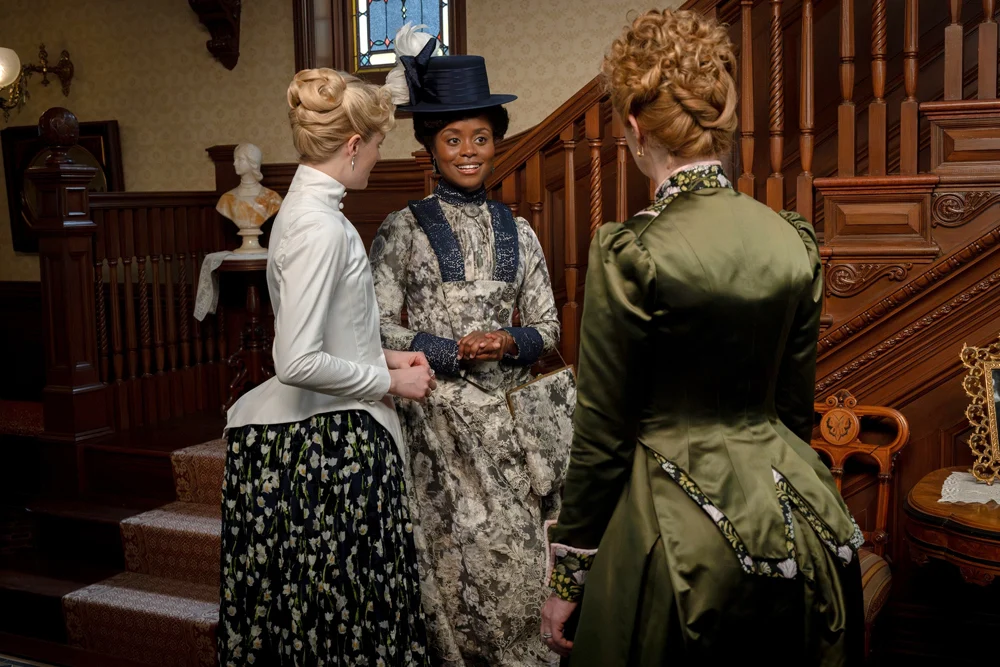

The premiere of the fourth season of HBO’s critically acclaimed period drama, The Gilded Age, plunges audiences back into the glittering yet ruthless world of late 19th-century New York and European aristocracy. Co-created by Julian Fellowes and Sonja Warfield, with direction by Salli Richardson-Whitfield, the season opener wastes no time reestablishing the intricate social hierarchies, personal scandals, and financial rivalries that define the era. Balancing historical friction with high-society melodrama, the episode sets the stage for a tumultuous season exploring the intersection of industrial ambition, racial politics, and personal reinvention.
High-Stakes Childbirth and Aristocratic Pressures Abroad
The episode opens far from Manhattan at the ancestral estate colloquially referred to as Schmownton Schmabbey, where the newly minted Duchess of Northumberland, Gladys Russell, is enduring a perilous labor. Dr. Thomas arrives to find Gladys in agonizing pain, watched over by a panicked Bertha Russell and the formidable, cold-eyed Lady Sarah. True to Fellowes’ penchant for high-tension medical emergencies reminiscent of his previous work on Downton Abbey, the delivery quickly turns critical when the baby is diagnosed as breech.

Faced with a devastating ethical dilemma common to the period’s obstetrics, the Duke of Northumberland is forced to choose between saving his wife or his heir. While Lady Sarah demonstrates a ruthless disregard for Gladys’s survival in favor of the aristocratic lineage, the Duke ultimately prioritizes the Duchess. Although mother and child survive, the aftermath reveals a cruel twist: Dr. Thomas quietly informs Bertha that Gladys has been left permanently sterile, a secret Bertha pressures the Duke to keep from her daughter. This harrowing subplot highlights the vulnerability of women within high-society marriages of convenience, where personal autonomy was frequently subordinated to dynastic preservation.
The Van Rhijn Lavender Marriage and New York Society
Back in New York, the Van Rhijn household serves as the launchpad for one of the season’s most anticipated social spectacles: the wedding of Oscar Van Rhijn and Enid Winterton, formerly the ambitious Mrs. Winterton (née Turner). Dispensing with traditional romantic conventions, the union is revealed as a textbook Victorian lavender marriage. Oscar secures a pragmatic path forward while maintaining his personal life, and Enid acquires the societal scaffolding necessary to reshape New York high society in her own image.
Agnes Van Rhijn, ever the traditionalist, is predictably sanguine about the match, celebrating the financial security it brings. However, the veneer of propriety is quickly challenged. Enid and Oscar harbor ambitions to cultivate a bohemian salon of artists and free-thinkers, directly defying the rigid conservatism championed by traditional matriarchs like Agnes. Furthermore, the revelation of Enid’s past—specifically her former employment as a lady’s maid across the street—threatens to detonate the carefully guarded secrets of the elite when the strict parlor maid Armstrong inevitably exposes her background to Agnes.

Industrial Tensions and the Russell Empire
Across the street in the opulent Russell household, George Russell is grappling with mounting financial and political pressures. Besieged by threats to his industrial empire and embroiled in fierce disputes with rival industrialists like John D. Rockefeller, George operates under heavy guard with Pinkerton agents stationed on his property. The introduction of early telephone technology underscores the rapid modernization of the era, even as George rails against the anti-monopoly policies of President Grover Cleveland.
George’s escalating paranoia and frustration spill over into his interactions with his son, Larry. While Larry pursues modern architectural ambitions—such as the conceptualization of early skyscrapers—his political naivety regarding President Cleveland’s administration places him at odds with his father. George’s increasingly autocratic demeanor marks a distinct shift in his character arc, transforming the once-sympathetic robber baron into a more formidable and isolated antagonist, mirroring the aggressive corporate titans of the Gilded Age.
Racial Politics and Social Realities in New York

The narrative also expands its focus on Peggy Scott and her family as she navigates the complexities of wedding planning with the formidable Mrs. Kirkland. Peggy’s impending marriage brings to the forefront the distinct stratification within Black high society, contrasted against the white elite’s superficial engagements.
A pivotal cultural collision occurs when President Grover Cleveland’s upcoming visit to New York prompts preparations by Agnes Van Rhijn for the Heritage Society. Peggy educates Ada and Marian on the deep-seated distrust many Black Americans held toward Cleveland due to his administration’s regressive policies regarding civil rights and the burgeoning Jim Crow era. This historical grounding prompts Agnes to reconsider her financial patronage of the presidential visit, illustrating how personal relationships with characters like Peggy gradually pierce the insular bubble of old New York society.
Scandal and Personal Reckoning
The episode’s emotional climax centers on Marian Brooks. Following the wedding reception, Marian attends a downtown gathering at Webster Hall alongside the newly married Van Rhijns. Reconnecting with Larry Russell, Marian’s normally cautious demeanor dissolves amid cocktails and dancing. When a carriage accident strands them overnight, a moment of uncharacteristic impulse leads Marian to cross a significant social and personal threshold.

By morning, the reality of the 19th-century double standard sets in. Overwhelmed by fear of reputational ruin, Marian retreats to the Van Rhijn home, where Agnes drops ominous warnings about the dangers of scandal for unmarried women. Though Peggy offers emotional sanctuary and reassures Marian of her worth, the lingering threat of public exposure hangs heavily over her future, foreshadowing profound societal consequences in subsequent episodes.
Broader Implications and Historical Context
Season 4, Episode 1 of The Gilded Age successfully bridges the personal dramas of its ensemble cast with the broader socio-economic transformations of the 1880s and 1890s. By intertwining themes of labor unrest, medical ethics, changing gender roles, and racial stratification, the series provides a textured backdrop that elevates its soap-opera elements.
The structural tension between the established aristocracy, the aggressive nouveau riche, and the marginalized voices navigating this rapidly industrializing landscape establishes a compelling trajectory for the remainder of the season. As characters like George Russell embrace a harder edge and younger figures like Larry, Marian, and Enid forge their own paths, The Gilded Age continues to interrogate the human cost of progress and prestige during one of America’s most contradictory eras.