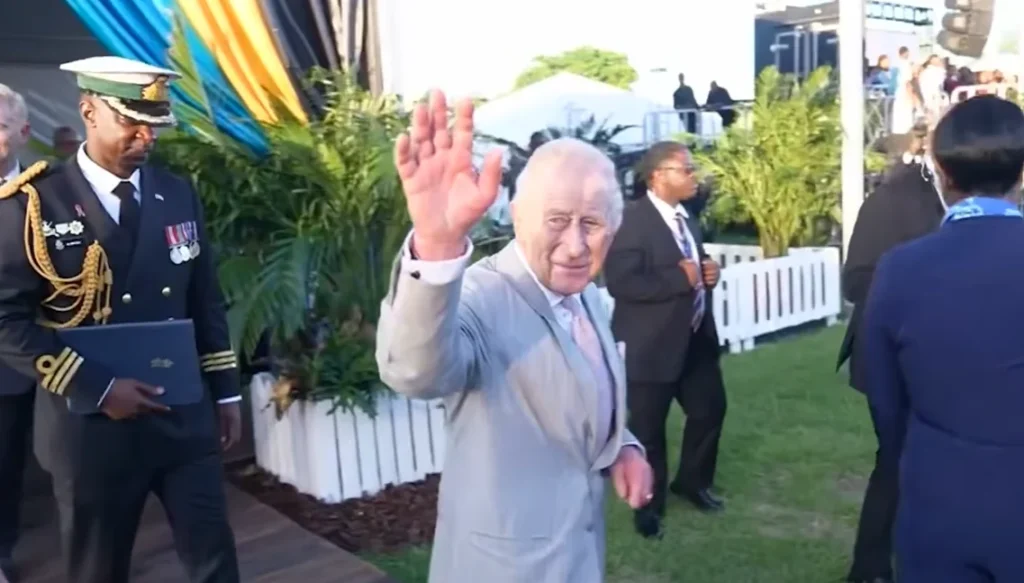

The second day of King Charles’s comprehensive nine-day Caribbean tour unfolded against a backdrop of deep historical reflection and maritime heritage on Wednesday, as the British monarch traveled to Her Majesty’s Bahamian Ship (HMBS) Coral Harbour. Stepping onto the naval base on the island of New Providence, the King’s itinerary centered on honoring military service, acknowledging historic sacrifices, and reinforcing the enduring ties between the United Kingdom and the Commonwealth of The Bahamas.
The focal point of the visit was a poignant memorial ceremony dedicated to four Royal Bahamas Defence Force (RBDF) marines who lost their lives more than four decades ago during a Cold War-era military incident. Throughout the day, His Majesty engaged with high-ranking government officials, active-duty service members, veterans, youth organizations, and surviving relatives, painting a vivid picture of a modern naval force rooted in operational readiness, humanitarian disaster response, and community resilience.
Main Facts and Official Reception
King Charles arrived at HMBS Coral Harbour to a full ceremonial welcome, reflecting the deep diplomatic and constitutional ties shared by the Commonwealth realm. Commodore Floyd Moxey, Commander of the Royal Bahamas Defence Force, greeted the monarch upon his arrival alongside a host of senior Bahamian political and military figures.
Among those welcoming His Majesty were Minister of National Security Myles LaRoda, Attorney General Wayne Munroe, and Captain Natasha Miller, Deputy Commander of the Defence Force.
The ceremonial grounds played host to a formidable Guard of Honour and Colour Party comprising 106 officers and marines. The contingent presented a precise Royal Salute as the military band performed a stirring Royal Fanfare followed by the national anthem of the Bahamas. Following the musical tribute, the King conducted a meticulous inspection of the Royal Guard, observing the discipline and readiness of the island nation’s maritime security force.
During the indoor portions of the visit, the monarch viewed a commemorative plaque designed to mark his presence at the base, alongside Coronation Medals destined for distribution to distinguished members of the Defence Force in forthcoming ceremonies. The display underscored the personal connection between the British Crown and the uniformed services of the Caribbean realm.
The Tragedy of HMBS Flamingo: Chronology and Historical Context
The most emotionally resonant portion of the royal itinerary occurred at the Flamingo Monument, where King Charles paused to remember the fateful events of May 10, 1980.
On that spring day, the RBDF patrol vessel HMBS Flamingo was operating in Bahamian territorial waters near the Cay Sal Bank when it intercepted two Cuban fishing vessels suspected of illegal poaching. After apprehending the vessels, the Flamingo was subjected to a sudden, unprovoked aerial assault by Cuban MiG fighter aircraft.
The strafing attack left the patrol boat heavily damaged and sinking. While several crew members managed to abandon ship and swim to safety, four young marines were trapped or killed during the assault:
- Able Seaman Fenrick Sturrup
- Marine Mechanic Austin Smith
- Seaman David Tucker
- Marine Edward Williams
The sinking of HMBS Flamingo stands as a watershed moment in modern Bahamian history. Formed only a few years prior in 1980, the Royal Bahamas Defence Force was thrust immediately into a national security crisis that tested the sovereignty and resolve of the newly independent nation—which had gained independence from the United Kingdom in 1973. The tragedy galvanized public support for the nascent military branch, cementing its status as an indispensable guardian of the archipelago’s vast and vulnerable maritime borders.
Walking up to the black granite and stone memorial bearing the names of the fallen, King Charles laid a ceremonial wreath. He stood in silent reflection for several moments before meeting directly with the families of the four deceased marines. In a remarkable historical convergence, the King also embraced Force Chief Petty Officer Gregory Curry, the sole surviving crew member of the ill-fated vessel who was serving aboard the Flamingo on the day of the attack.
Expanding Naval Capabilities: Humanitarian and Security Missions
Shifting from historic remembrance to contemporary operational duties, the King proceeded to tour the HMBS Lawrence Major. Named in honor of one of the pioneering figures of the Bahamian maritime service, this 56-metre vessel represents a vital asset for the island nation.
Unlike traditional combat vessels, HMBS Lawrence Major is primarily engineered to respond to the catastrophic natural disasters that regularly plague the Caribbean basin. From severe Atlantic hurricanes to tropical storms, the ship acts as a floating command center capable of delivering emergency supplies, medical relief, and logistical support to isolated Family Islands following extreme weather events.
Aboard the vessel, the monarch was introduced to Commander Alexis Brown, the ship’s commanding officer. King Charles toured the bridge and lower decks, holding conversations with members of the ship’s company, representatives from the Disaster Risk Management Unit, retired service personnel, and military veterans.
The discussions highlighted the evolving mandate of modern navies. In an era defined by intensifying climate change impacts, sea-level rise, and extreme weather volatility, organizations like the RBDF find themselves increasingly on the front lines of humanitarian assistance and disaster relief (HADR), shifting from traditional defense paradigms to comprehensive civil protection.
Investing in the Future: Youth Programs and Community Engagement
The final segment of the Coral Harbour visit emphasized the importance of human capital development through structured youth initiatives. The King met with enthusiastic participants from the Royal Bahamas Defence Force Rangers Youth Programme and the Bahamas National Youth Guard.
These programs are specifically designed to cultivate civic responsibility, discipline, leadership, and technical skills among young Bahamians. By channeling youth energy into structured military-style training, community service, and environmental stewardship, the Defence Force plays a critical role in social cohesion and crime prevention across the islands.
King Charles spent considerable time interacting with the young cadets, asking about their training regimens, aspirations, and community projects. Observers noted that the engagement reflected the monarch’s lifelong commitment to youth empowerment through initiatives like The Duke of Edinburgh’s Award, adapting similar developmental philosophies to the Caribbean context.
Broader Impact and Implications of the Royal Tour
The visit to HMBS Coral Harbour carries significant symbolic and geopolitical weight within the broader framework of the British monarchy’s relations with Caribbean Commonwealth realms.
The nine-day tour—which began in the Bahamas on Tuesday—takes place during a period of complex constitutional evolution across the Caribbean. Several nations in the region have signaled or initiated transitions toward republican status in recent years, prompting deep conversations regarding the future of the Commonwealth and the legacy of the British Empire.
By foregrounding shared history, mutual sacrifices during security crises, and cooperative humanitarian frameworks, royal tours of this nature seek to reinforce interpersonal and institutional bonds that transcend political debates over constitutional forms of government. The emotional gravity of honoring the HMBS Flamingo martyrs demonstrated a deep, respectful acknowledgment of Bahamian national identity and sovereignty.
Following the conclusion of his engagements in the Bahamas, King Charles will board transport to Guyana to continue bilateral meetings. From there, he will travel onward to Antigua and Barbuda, where Queen Camilla is scheduled to join him for the high-level deliberations of the Commonwealth Heads of Government Meeting (CHOGM).
As the Royal Bahamas Defence Force continues to patrol its 100,000 square miles of ocean, guard against transnational crime, and rescue citizens from the wrath of Atlantic hurricanes, Wednesday’s royal visit serves as a enduring reminder of the foundational sacrifices made by those who wear the uniform—ensuring that the memory of the Flamingo four remains permanently woven into the fabric of the nation.